

Prepositions of Place Game: A Teacher’s Guide to Pirate Island

A pencil can be in a box, on the box, or under it. The objects stay the same, but one small word changes the meaning. Students need opportunities to connect those words with what they can see—and then use them in sentences.
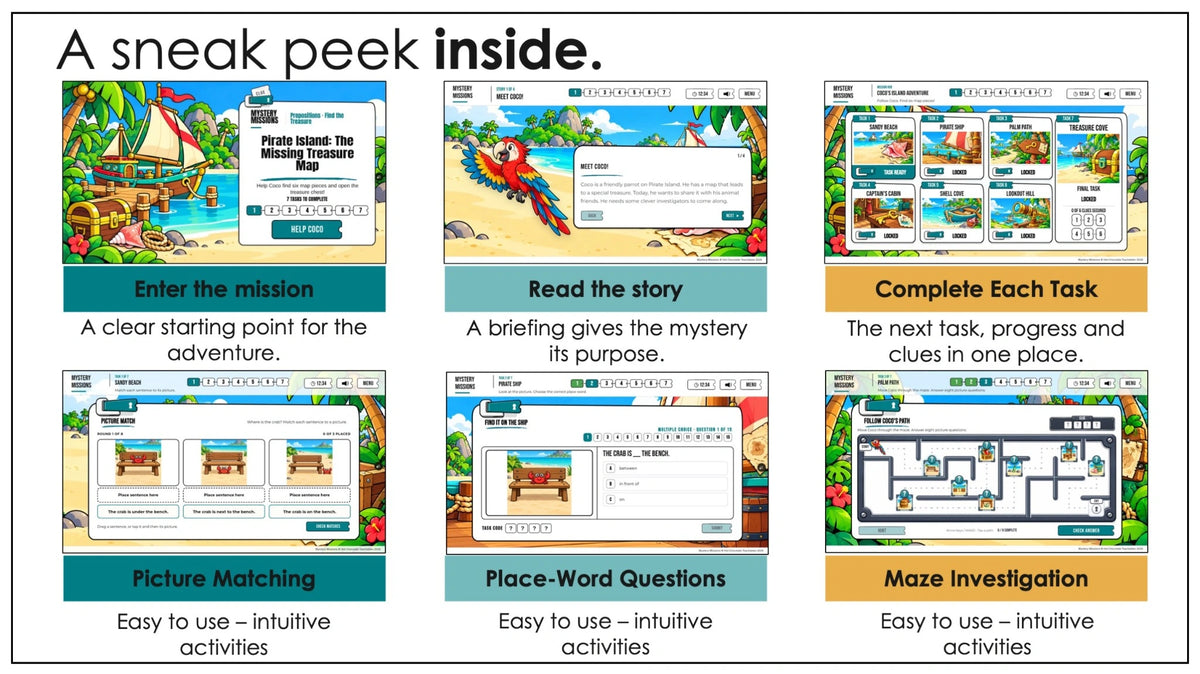
Pirate Island: The Missing Treasure Map is a prepositions of place game that turns this language practice into an illustrated mystery. Students help Coco recover six map pieces through seven interactive challenges, collecting clues as they work toward the final treasure mystery.
Designed for Grades 1–3, this Mystery Mission combines picture-based activities, reading, and sentence building. It can also support ESL learners whose language and reading levels match the activities. Here is what students practice and how to build a useful lesson around the adventure.
A pirate adventure with a clear grammar goal
Coco needs help recovering a missing treasure map. The adventure takes students through Sandy Beach, Pirate Ship, Palm Path, Captain’s Cabin, Shell Cove, Lookout Hill, and Treasure Cove. Each completed task brings them closer to recovering the map and solving the treasure mystery.
The story connects the language work: students read directions, look at illustrated scenes, and use place words to describe relationships between objects. The mission is an online activity played in a browser, with printable prepositions worksheets included for additional practice.
You can explore the screenshots and resource details in the Pirate Island prepositions of place game listing.
Which prepositions of place do students practice?
The mission focuses on seven expressions: in, on, under, behind, between, next to, and in front of. Students connect these words with object positions, match sentences to illustrations, and build sentences using place words.
Before playing, check that learners can identify both objects in a description. In “The key is under the chair,” they need to understand key, chair, and the relationship expressed by under.
The following are suggested teacher-created warm-up examples, not a list of questions taken from the game:
| Place word | Classroom example | What to notice |
|---|---|---|
| in | The pencil is in the box. | The pencil is inside the container. |
| on | The pencil is on the book. | It rests on the book’s surface. |
| under | The pencil is under the book. | Identify the object used as the reference. |
| behind / in front of | The cup is behind the box. | Agree on the viewpoint before describing the scene. |
| between | The pencil is between two books. | Name the two surrounding objects. |
| next to | The cup is next to the box. | Describe the objects beside each other. |
What do students do during the mission?
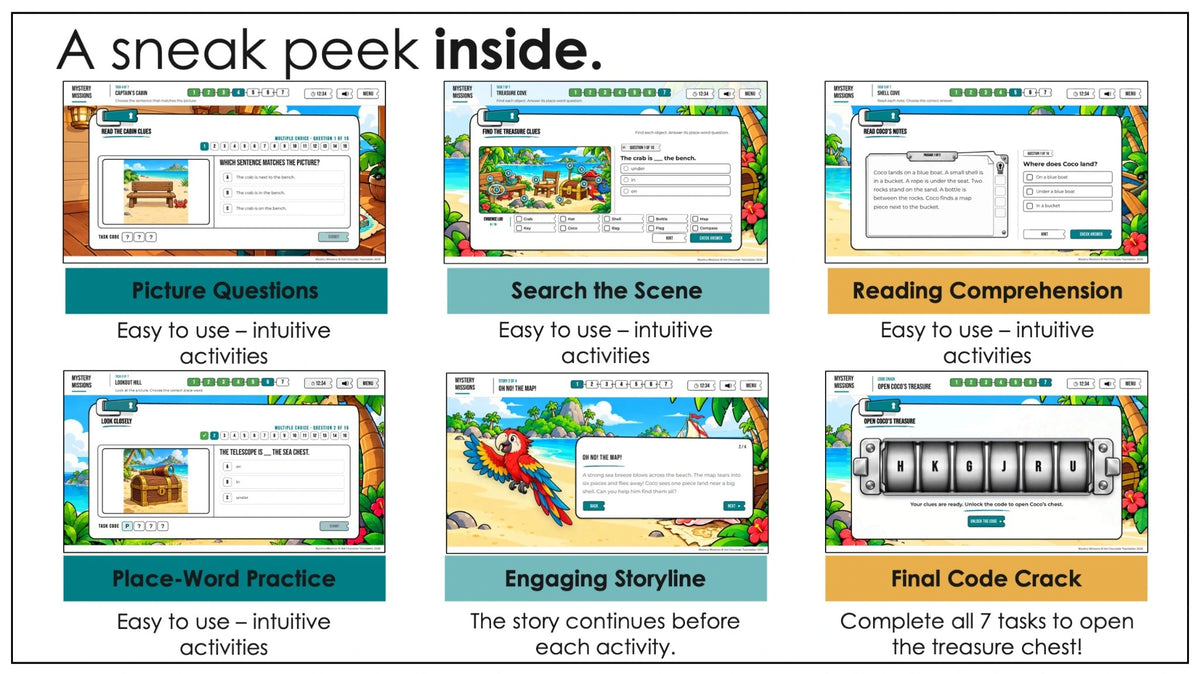
Pirate Island uses several activity formats to revisit the same language focus. Students match pictures, answer place-word questions, work through an illustrated maze, build sentences, read short passages, and investigate scenes.
The search-the-scene activity includes two rounds with different artwork and 20 questions. Across the adventure, learners need to compare what a sentence says with what the picture shows. They also follow story sections and collect clues for the mystery.
As students work, listen for explanations such as “I chose between because there is an object on each side.” That discussion gives you information about their understanding beyond whether they selected an answer.
How to set up Pirate Island for your class
- Activate your purchase. Follow the instructions in the purchase PDF, enter the teacher activation code, and verify your teacher email.
- Open the teacher dashboard. Select the mission, review the available resources, and check the classroom settings, including progress tracking and the optional timer.
- Generate a classroom code. Share the six-digit code and the student-page address provided by the dashboard.
- Help students join. Learners enter the classroom code and choose a nickname or team name. Student email accounts are not required.
Use an internet-connected computer, laptop, Chromebook, or compatible tablet in landscape orientation. No app installation is needed, and gameplay is not designed for phones. Test the page on your school’s devices before the lesson.
Classroom codes remain active for 72 hours from creation. Generate a new code when you need a new session; progress from an expired code does not transfer. The classroom-code deadline does not expire your purchased teacher license.
For current instructions, see How Mystery Missions Work and the setup and troubleshooting guide.
A practical lesson plan for prepositions of place
Before playing: move an object, change the sentence
Set out a box, a pencil, two books, and a cup. Move one object at a time while keeping the others still. Ask students to complete “The pencil is ___ the box,” then invite a volunteer to place it somewhere else.
Spend a few minutes on easily confused positions. Keep the class facing the same direction when modeling behind and in front of. Preview unfamiliar story words such as map, ship, island, and treasure chest.
During the mission: make time to explain
Allow about 30 minutes for gameplay, with additional time for joining, reading support, and discussion. A lesson with a five-minute warm-up, setup, the mission, and a short follow-up may need around 45 minutes. Treat that as a planning example and adjust for your learners.
When a student is unsure, ask them to name the objects and describe their positions before choosing an answer. Avoid supplying the place word immediately; their explanation may show whether the difficulty is vocabulary, reading, or the spatial relationship.
After playing: check the language independently
Use the included printable worksheets or create a quick exit task with classroom objects. Ask each learner to write two sentences describing a new arrangement, or give a direction that a partner follows. These are suggested follow-up activities you can add around the game.
Look for accurate place words and clear reference objects. Completing a mission and using the language independently provide different kinds of evidence, so include both in your review.
Choose a classroom format that fits your learners
Independent practice
Use independent play when students can read the directions with manageable support. A small reference chart with the seven place words can help learners check a meaning without interrupting every task.
Partner work or small teams
Give learners rotating jobs: reader, picture checker, and answer selector. With two students, combine the first two jobs and swap regularly. Ask partners to agree on a complete sentence before entering an answer.
Whole-class guided practice
Display the mission from a compatible computer connected to an interactive whiteboard. Give everyone thinking time before discussing a choice. Students can sketch an object’s position or write the place word on paper, helping you hear from more than the quickest volunteers.
Support and extend the language practice
For learners who need support, review object vocabulary, read directions together, and provide a sentence frame: “The ___ is ___ the ___.” Use a physical demonstration when an illustrated relationship is unclear.
For a greater challenge, ask students to describe the same arrangement in two ways, name both reference objects when using between, or write directions for a partner to follow. These suggested extensions add speaking and writing without changing the mission itself.
New to the series? Start with our teacher’s guide to Mystery Missions for an overview of the platform.
An optional tool for classroom discussion
As an Amazon Associate I earn from qualifying purchases. This post contains affiliate links. I may earn a commission at no extra cost to you.
During a teacher-led picture discussion, Learning Resources Hand Pointers can help learners identify the two objects in a place-word sentence. Ask them to point first and describe the position second. The pointers are optional classroom accessories and are not required to play Pirate Island.
Frequently asked questions about Pirate Island
Is this a printable escape room?
The main adventure is an online prepositions game. The purchase PDF provides activation instructions, and printable worksheets offer additional practice.
Can I use it with ESL learners?
Yes, when the vocabulary, reading demands, and target language suit the class. Preview key words and use partner or teacher-led play when learners need support.
Do students need accounts?
Students join with a classroom code and a nickname or team name. The teacher uses email verification for teacher access.
Can I monitor the class?
The teacher dashboard includes progress tracking and an optional timer. Check the settings before students begin, and use their explanations alongside the dashboard when reviewing learning.
Help Coco recover the map—and give place words a purpose
Pirate Island connects prepositions of place with a story students can follow, pictures they can examine, and clues they can collect. Begin with familiar objects, support careful reading, and finish with a fresh opportunity to describe where something is.
Explore Pirate Island and see the activity previews. You can also view the resource on Teachers Pay Teachers.


