

Plural Noun Games for Grades 2–3: Solve the Mixed-Up Zoo Mystery

One animal, several animals. One butterfly, several butterflies. Students may understand the idea of more than one and still need practice choosing the correct plural spelling in a sentence. The Case of the Mixed-Up Zoo turns that review into an illustrated investigation with a clear purpose: help Nicky and Clio restore Sunnybrook Zoo before opening time.
This digital plural noun game for grades 2–3 combines seven interactive challenges, a connected story, and clues that lead to a final mystery. Here is a closer look at the adventure, the language students practice, and ways to build a useful classroom lesson around it.
What is The Case of the Mixed-Up Zoo?
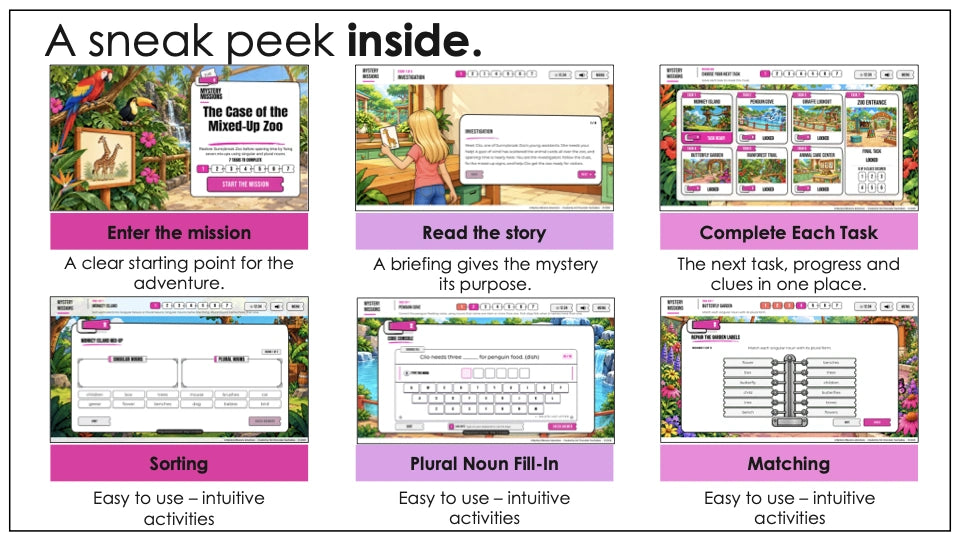
Animal identification signs, garden labels, feeding notes, and zoo records have become mixed up. Students help put things back in order by working with singular and plural nouns throughout the adventure.
The story takes learners through Monkey Island, Penguin Cove, Giraffe Lookout, Butterfly Garden, Rainforest Trail, and the Animal Care Center before the Zoo Entrance challenge. Completed tasks reveal clues, which stay together in Mission Control for the final mystery.
The main activity is played online. Optional printable plural noun worksheets are also included in the teacher resources area, giving you another way to revisit the language after the game.
View The Case of the Mixed-Up Zoo and its product previews.
Which plural noun skills do students practice?
The mission focuses on recognizing singular and plural nouns, choosing noun forms in sentence context, and working with these spelling patterns:
- Adding -s to form regular plurals.
- Adding -es where the word requires that ending.
- Changing consonant + y to -ies.
- Recognizing irregular plural nouns that do not follow a regular ending pattern.
Use the game after introducing these ideas, so students can apply familiar language while following the story. Reading the instructions and clues also gives them a reason to slow down and consider the meaning of each task.
A quick teaching reminder about -ies
Before playing, contrast a consonant + y example with a vowel + y example. In a teacher-created warm-up, you might compare butterfly → butterflies and monkey → monkeys. Ask students to look at the letter before the y. This helps you avoid teaching the misleading shortcut that every word ending in y changes to -ies.
These are suggested classroom examples, not a list of the mission’s questions. Choose additional words your class has already encountered.
What do students do in the game?
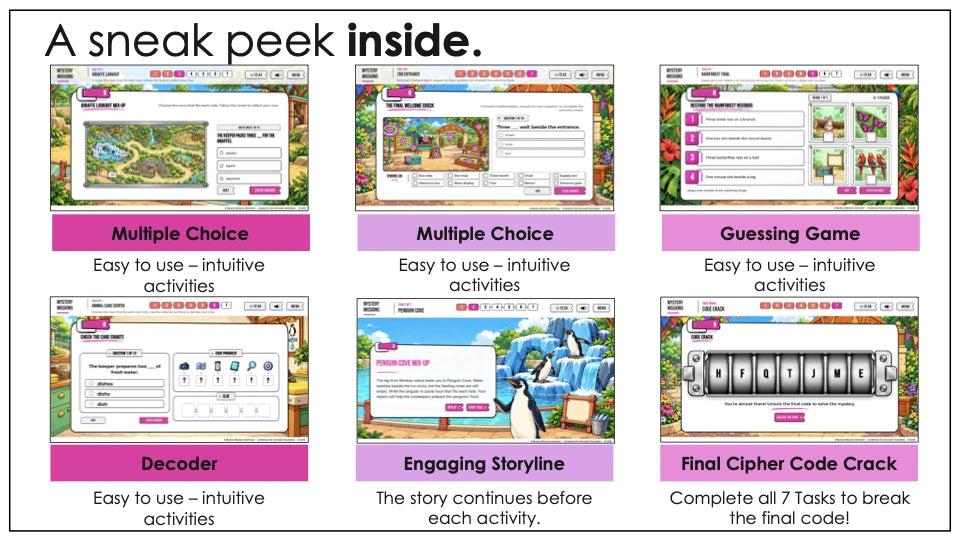
The seven challenges use formats including sorting, matching, fill-in sentences, multiple-choice questions, and picture-based clues. A final cipher challenge brings the investigation together. The varied tasks ask learners to do more than repeat a single worksheet format.
Before students submit an answer, encourage them to consider two questions: “Does the sentence need one or more than one?” and “What spelling does that noun need?” This separates the meaning decision from the spelling decision, making their reasoning easier to discuss.
In partner work, one learner can read the sentence while the other explains the noun form. Then they agree before responding. Switch roles regularly so both students contribute.
How to set up the Zoo Mystery for your class
- Activate your purchase. Follow the instructions in the purchase PDF, enter its activation code, and verify your teacher email.
- Open the mission in your dashboard. Review the available resources, progress settings, and optional timer.
- Create a classroom code. Share it with the student-page address provided in the dashboard.
- Have students join. They enter the classroom code and choose a nickname or team name. Student email addresses are not required.
- Begin the adventure. Model how you want students to read, discuss, and check their choices.
A classroom code is active for 72 hours from creation. Check its deadline before planning a second session. A new code starts a new session; progress from an expired code does not transfer. The classroom-code deadline does not expire your purchased teacher license.
Use a computer, Chromebook, or compatible tablet in landscape orientation with internet access. No app installation is needed, and gameplay is not designed for phones. Test the school device and network before class. The How It Works guide and setup and troubleshooting page provide current instructions.
A practical plural noun review lesson
The estimated gameplay time is 30–35 minutes, depending on reading level and pace. Add time for joining, a warm-up, and discussion. If your lesson period is short, use the follow-up during the next class.
Before the mission: notice the change
Write three teacher-created pairs on the board: bird/birds, box/boxes, and child/children. Ask students what changed and why. Then have them explain which example follows a different pattern. Keep the review brief and focus on language they will recognize.
During the mission: listen for the explanation
As students work, ask a few learners to explain a choice. A useful prompt is, “What told you this noun needed to be plural?” Listen for evidence from the sentence or picture rather than accepting only “It looked right.” Use dashboard progress monitoring alongside these conversations.
After the mission: check independent use
Try this suggested exit ticket: “Write one sentence about a zoo using a regular plural noun. Then write another using an irregular plural noun.” Ask students to circle the nouns. Their new sentences provide a different check from completing the game and help you plan the next lesson.
Classroom options and support for different learners
Independent review or partner practice
Independent play suits students who can read the directions and use the target grammar with some confidence. Partners can share a device and talk through decisions. Assign a reader and an answer-checker, then rotate roles after a challenge.
A teacher-led zoo investigation
Display the mission through a compatible computer connected to your interactive whiteboard. Give everyone thinking time before inviting an answer. Students can write their choice on paper first, then explain it to a partner. This gives quieter learners a way to participate in the review.
Support for ESL learners and developing readers
Preview essential zoo vocabulary and model an instruction before students begin. Offer a small reference with one example of each plural pattern. Read directions aloud when needed, while leaving the grammar decision to the learner. Consider leaving the optional timer off when reading support is your priority.
An extension for students ready for more
Invite learners to create a short zoo notice using several plural nouns, such as a feeding reminder or visitor announcement. Have a partner underline the nouns and explain the spelling changes. This is an optional teacher-created extension, separate from the included digital activities.
New to the series? Start with our teacher’s guide to Mystery Missions for an overview of the platform.
An optional tool for classroom discussion
As an Amazon Associate I earn from qualifying purchases. This post contains affiliate links. I may earn a commission at no extra cost to you.
For a shared-board follow-up, Learning Resources Hand Pointers can help students point to a noun ending while explaining a spelling change. Invite them to identify both the singular form and the plural form. These are optional discussion tools; the online game does not require them.
Frequently asked questions
What grade levels is the Zoo Mystery designed for?
The mission is designed for grades 2–3. For ESL groups, consider reading level and familiarity with plural forms when deciding whether to use independent, partner, or teacher-led play.
Does it include regular and irregular plural nouns?
Yes. Students practice singular and plural nouns, -s, -es, -ies, irregular plurals, and choosing the appropriate noun form in sentence context.
Is this a printable escape room?
The main mystery is an online game. The purchase PDF provides activation instructions, and optional printable plural noun worksheets are available through the teacher resources area.
Do students need accounts or email addresses?
No. Students join with the teacher’s classroom code and a nickname or team name. The teacher uses email verification for teacher access.
Bring plural noun practice into the zoo
Choose The Case of the Mixed-Up Zoo when your class is ready to revisit plural forms through a connected adventure. Start with a short review, give students time to explain their choices, and finish with a new example they can complete independently.
Explore The Case of the Mixed-Up Zoo. You can also view the mission in the Mystery Missions marketplace or find the resource on TPT.


