

Sentence Building Activities that your students will LOVE!|

Sentence structure becomes easier when students can see, move, and discuss the words. If your ESL learners struggle with word order, complete sentences, or forming questions, short hands-on activities can make grammar practice much more understandable.
These sentence-building activities are designed for English language learners at different levels. Use them in small groups, as a whole-class review, or as independent practice. Each one gives students repeated opportunities to arrange words, check meaning, and explain why a sentence is correct.
Explore Sentence-Building Activities

1. Solve a sentence-building escape room
An escape-room format turns sentence practice into a shared challenge. Students read a short story, complete a series of word-order and grammar tasks, and collect information that helps them solve the final mystery.
Unlike a traditional breakout game, a printable language escape activity does not require complicated locks or technology. Learners can focus on arranging jumbled sentences, reading directions, and explaining their answers to teammates.
Browse the ESL escape activity collection to find sentence-building challenges that are ready to print and use.
How the escape activity works
- Introduce the story: read the scenario together and review any key vocabulary.
- Form small teams: assign a reader, recorder, checker, and speaker.
- Complete seven tasks: students arrange words, answer questions, and use sentence clues to move forward.
- Check each stage: review the answer before giving the group its next clue or signature.
- Solve the mystery: teams use the final code to identify the answer and celebrate their success.
Give students sentence frames such as “We put ___ first because…” and “The question needs ___ before ___.” This encourages them to talk about grammar instead of silently moving pieces around.
2. Build sentences with a board game
A board game adds a clear goal and a little friendly competition to sentence practice. Students roll a die, move their piece, and draw a jumbled sentence card when they land on a space. To stay on the space, they must put the words in the correct order and read the complete sentence aloud.
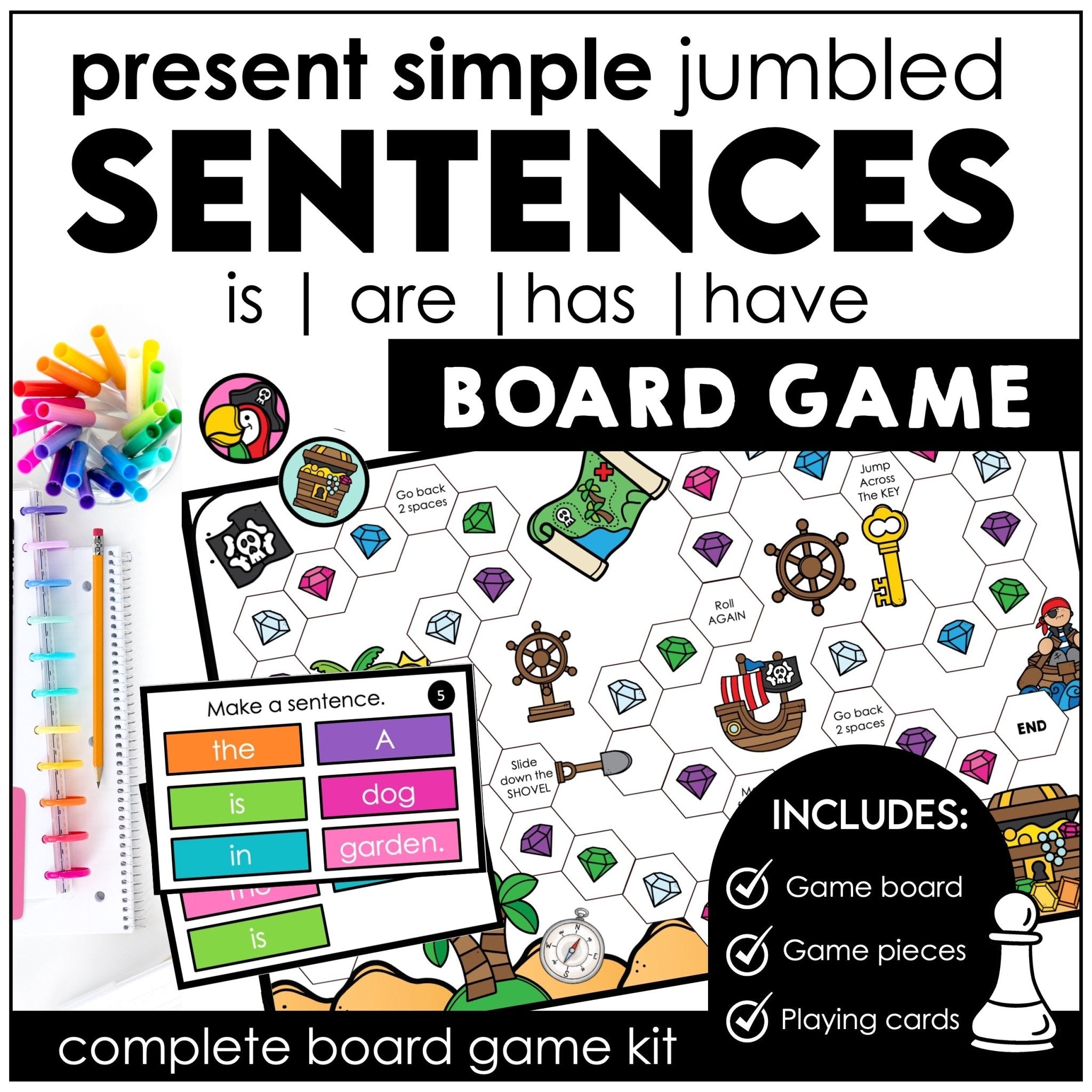
The Present Simple sentence-building board game focuses on the verbs be and have. It includes a printable board, 48 sentence and question cards, game pieces, directions, an answer key, and a recording sheet.
Make the game language-rich
- Ask students to explain why the subject comes before the verb.
- Have partners change a positive sentence into a negative sentence.
- Challenge learners to turn a statement into a question.
- Give a bonus point for a second sentence using the same structure.
- Let students keep a list of errors to review at the end of the lesson.
For easy storage, keep the cards in labeled bags or task-card boxes. (This is an affiliate link.)
3. Practise with interactive Boom Cards
Digital sentence-building activities are helpful when students need immediate feedback. Learners drag and drop words into the correct order, submit an answer, and see whether the sentence works before trying the next card.
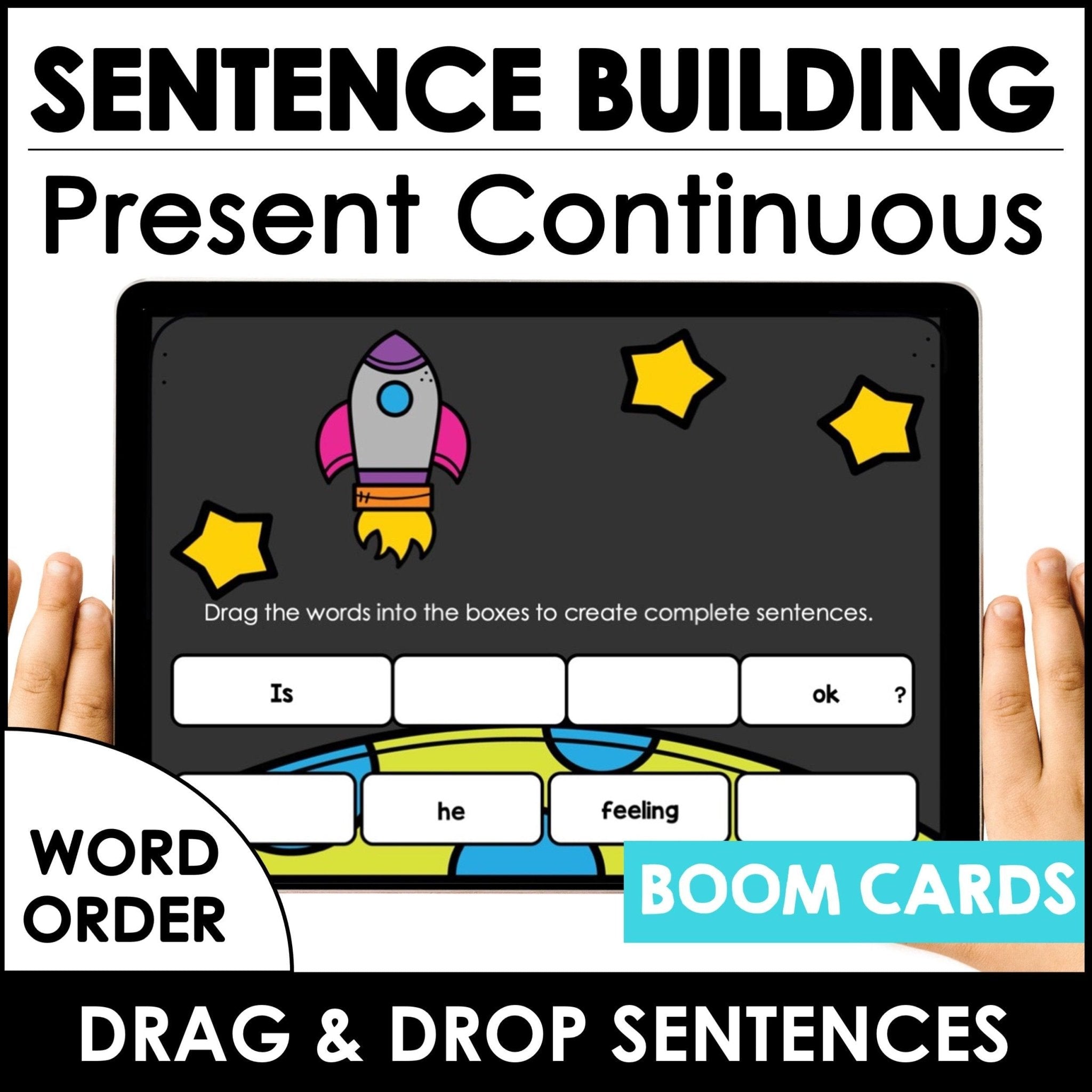
Use the Sentence Building Present Continuous Boom Cards for independent practice, fast finishers, homework, or a whole-class warm-up. Because the cards are self-checking, students can practise without waiting for the teacher to mark every answer.
Support different learners
- Beginning learners: read the words aloud together and highlight the capital letter and full stop.
- Intermediate learners: ask students to explain the word order after submitting an answer.
- Advanced learners: have students write a second sentence using the same verb tense.
For more digital options, browse sentence-building Boom Cards and choose a deck that matches your current grammar target.
4. Cut up and rebuild sentence strips
Hands-on sentence strips are an excellent bridge between word-level work and paragraph writing. Students physically arrange fragments, read the sentence, and adjust the order until the meaning and grammar are correct.
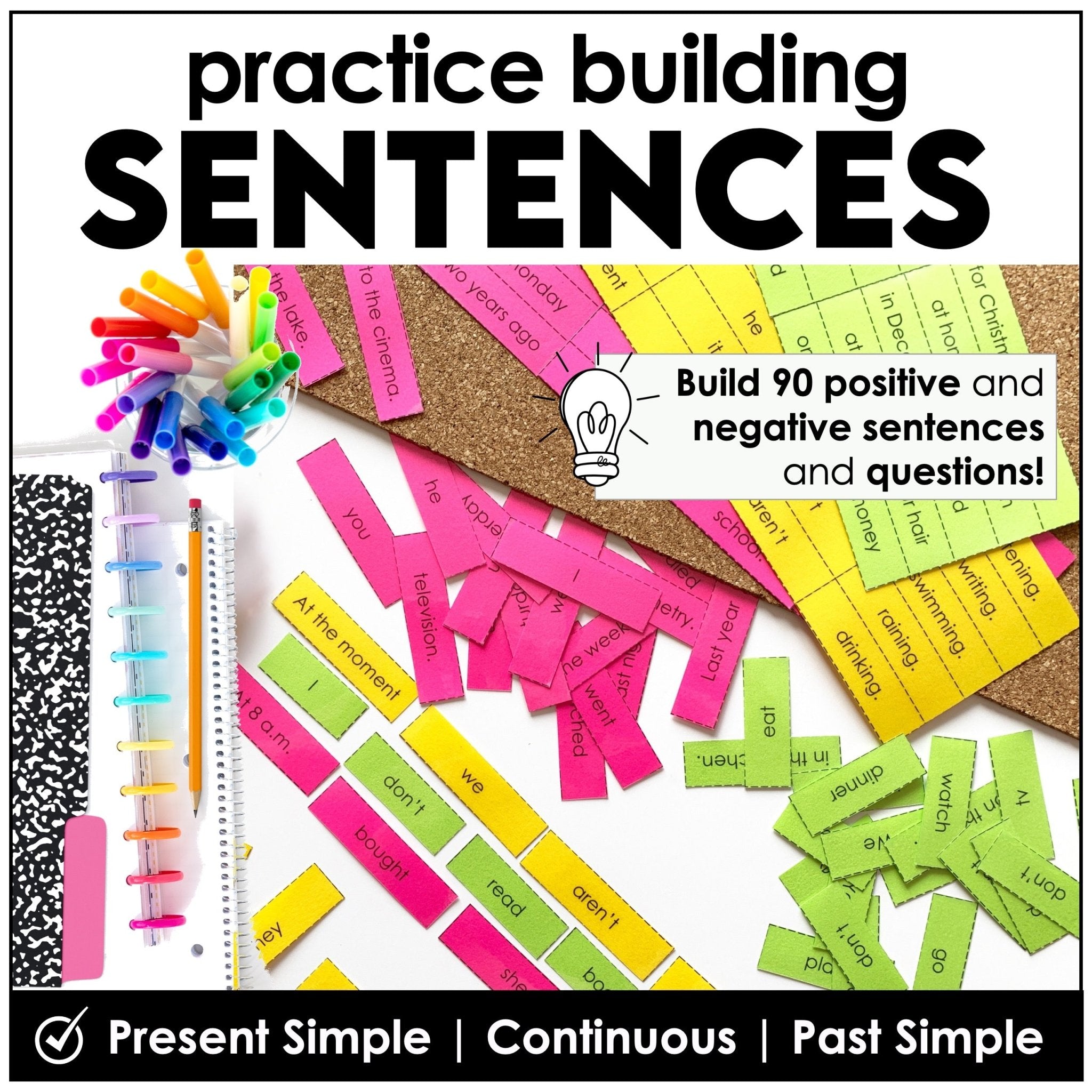
The Mixed-Up Sentence Activity includes Present and Past Tense sentences and questions. Students can work together to build as many correct sentences as possible, then copy their best examples into a notebook.
Three ways to extend the strips
- Read and check: partners read the sentence aloud and check punctuation and meaning.
- Change the form: students make the sentence negative or turn it into a question.
- Add a detail: learners add an adjective, adverb, time phrase, or place phrase.
For a quick station, place the word fragments in an envelope with an answer key. Students can self-check after they have agreed on an order and explain their choice.
5. Play a question-building game show
Game shows are a lively way to review word order with the whole class. Teams choose a point value, arrange the jumbled words, and earn points when they produce a complete sentence or question.

The Sentence Building Game Show includes multiple grammar categories and interactive questions. Students choose the value they want to attempt, discuss the answer, and reveal the correct sentence before adding points to their team total.
Language targets to review
- Word order in statements and questions
- The verbs be and have
- Regular and irregular verbs
- Positive and negative forms
- Question words and auxiliary verbs
A Present Continuous version is also available in the sentence-building game show collection.
Turn sentence building into a complete lesson
- Warm up: display one jumbled sentence and invite students to predict the first word.
- Model: think aloud as you identify the subject, verb, and punctuation.
- Practise: choose an escape room, board game, digital deck, sentence strips, or game show.
- Communicate: ask students to read, explain, and ask a follow-up question.
- Reflect: have learners write one sentence they built and one rule they remembered.
Use a quick exit ticket to see who can build a statement, a negative sentence, and a question. This gives you a clear starting point for the next lesson.
Differentiate without creating five separate lessons
- Newcomers: use color-coded word cards, pictures, and a limited number of fragments.
- Developing learners: provide a word bank and let partners rehearse before writing.
- Intermediate learners: require an explanation and a second example.
- Advanced learners: ask students to create their own jumbled sentence for a classmate.
Pairing students thoughtfully can make a big difference. Give confident speakers a role that supports the group without allowing them to do all the thinking, and rotate the reader, writer, checker, and speaker.
Ready to help students build stronger sentences?
Start with one short activity and one clear language target. When students can move words, test an idea, hear the sentence aloud, and try again, sentence structure becomes something they can understand and use—not just a rule they have to memorize.
Browse all sentence-building activities on Hot Chocolate Teachables for printable and digital resources you can use throughout the year.
Happy teaching!


