

How to Boost ESL Writing Skills with Digital Quick-Write Journals

Teaching writing in ESL can feel difficult, not because students do not want to write, but because many of them do not know how to begin. Beginners often freeze when they see a blank page. Intermediate learners rely on short, repetitive sentences. More advanced students may avoid mistakes by keeping their writing very simple.
If that sounds familiar, you are not alone. Many teachers notice that their students can speak more easily than they can write. Others find that students understand grammar during practice activities but struggle to use it in their own sentences. That is why digital and printable quick-write journals are such a helpful classroom tool. They give students structured, level-appropriate writing practice they can do regularly without feeling overwhelmed.
In this post, you will see how two beginner-friendly ESL writing journals can support writing growth all year long:
- Present Simple Writing Prompt Journal — Teachers Pay Teachers | Hot Chocolate Teachables
- Past Simple Writing Prompt Journal — Teachers Pay Teachers | Hot Chocolate Teachables
Both resources are available in print and digital formats, which makes them ideal for classroom teaching, online learning, and blended instruction.
Why Writing Prompt Journals Work So Well for ESL Students
Traditional ESL writing lessons often leave out the bridge between grammar practice and real writing. Students may complete gap fills, sentence scrambles, or multiple-choice grammar tasks successfully, but then freeze when they are asked to write independently.
Writing prompt journals solve that problem. They give students a clear topic, built-in support, and repeated opportunities to use the same grammar and vocabulary in meaningful ways. Over time, students do not just complete writing tasks. They begin to internalize the language patterns they need for more confident, independent writing.
Common Teacher Problems These Journals Help Solve
- Beginners do not know what to write. Prompts provide a topic, clear direction, and vocabulary support.
- Students write the same short sentences again and again. Prompts help them gradually expand their ideas and sentence structures.
- You need something that works for mixed levels. These journals include scaffolds as well as room to extend writing.
- You teach both digital and paper students. Each set includes Google Slides, editable PDF, and printable pages.
- You want a low-prep weekly writing routine. These prompts are easy to reuse all year.
Present Simple Quick Write Journal for ESL Students
If you need beginner-friendly Present Simple writing prompts, this journal is a practical resource for your writing routine. It includes 42 structured quick-write prompts that become more challenging little by little, helping students build confidence without feeling overwhelmed.
Present Simple writing is one of the most important starting points in ESL. Students use it to talk about routines, preferences, habits, and personal information. It also helps them build strong sentence patterns and subject-verb agreement.

Grammar and Writing Skills Practiced
- Present Simple sentence structure with affirmative, negative, and question forms
- Adverbs of frequency such as always, usually, sometimes, and never
- Descriptive adjectives to improve sentence quality
- Sequencing words like first, then, next, and finally
- Basic paragraph writing in a guided and manageable way
Writing Categories Included
- Introduce Yourself – 5 prompts
- My Favorites – 13 prompts
- My Routine – 8 prompts
- How-To and Giving Instructions – 8 prompts
- Describe It – 8 prompts
Each writing page includes hints and vocabulary support, which makes it much easier for students to begin writing successfully.
Example of Present Simple Writing in Action
For a routine prompt, students may write sentences like:
- I wake up at 7:00.
- I usually eat breakfast at home.
- On Mondays, I go to school by bus.
Because students repeat these patterns across many prompts, the grammar begins to feel natural instead of forced.
Ways to Use the Present Simple Journal
- Assign one or two prompts each week to build a predictable writing habit.
- Model a short response first and highlight the grammar target.
- Encourage students to use the hint line when they are unsure how to start.
- Focus on fluency before accuracy during the first draft.
- Turn written responses into speaking practice by having students share with a partner.
You can find this resource here:
Past Simple Quick Write Digital Notebook for ESL Writing
Once students can write comfortably in Present Simple, the next major step is Past Simple writing. This can be challenging because students need to remember both regular and irregular verbs while also organizing events clearly in time.
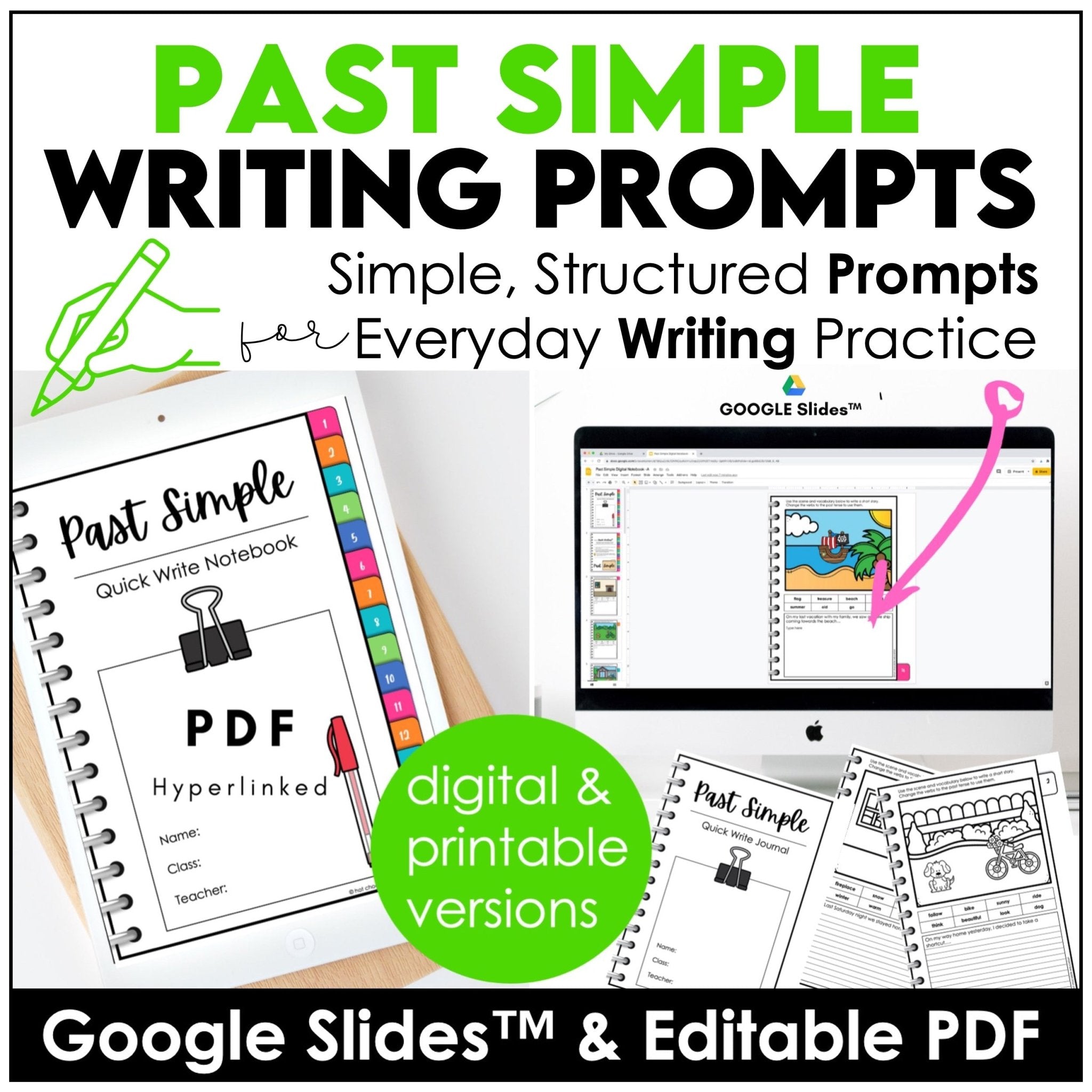
The Past Simple Writing Prompts Quick Write Notebook gives students repeated practice with meaningful past-tense writing tasks while still offering the support they need to succeed.
Why This Past Simple Journal Is Helpful
- Students get repeated past-tense practice in real contexts.
- You can assign prompts in any order to match your current unit.
- Vocabulary hints are built in to reduce frustration and increase output.
- Multiple formats make it flexible for digital, hybrid, and printable teaching.
What Is Included
- Google Slides version with editable text boxes
- Hyperlinked digital PDF with tabs and editable answer spaces
- Printable low-ink PDF with lines for handwritten writing journals
Grammar and Language Targets
- Past Simple regular verbs such as watched, visited, and studied
- Past Simple irregular verbs such as went, saw, ate, and had
- Time expressions like yesterday, last weekend, and two days ago
- Sequencing and storytelling language for clearer past-tense narratives
Example of Past Simple Writing
For a prompt about the weekend, students may write:
- Last weekend, I visited my grandparents.
- On Saturday, we went to the park and played soccer.
- Then we ate pizza and watched a movie.
These responses help students use past verbs in a meaningful way instead of only recognizing them on worksheets.
Why This Journal Helps Build Writing Fluency
- It gives students repeated practice with regular and irregular verbs.
- It supports longer and more confident writing over time.
- It works well for digital, blended, and paper-based classrooms.
- It encourages students to write complete ideas instead of isolated answers.
This journal also pairs well with irregular verb games and charts, especially if your students need extra support with Past Simple accuracy.
You can find the Past Simple journal here:
Printable or Digital? How to Choose the Best Format
One of the most useful things about these journals is that you do not have to choose just one format. You can use the version that fits your classroom best, or combine both.
Benefits of the Digital Format
- Students type directly into Google Slides or editable PDFs.
- No printing is needed.
- It is easy to assign through Google Classroom or another learning platform.
- Students can revise and improve their writing without rewriting everything.
Benefits of the Printable Format
- Students create a physical writing journal they can keep.
- It supports handwriting practice along with writing fluency.
- It works well for morning work, centers, or bell ringers.
- Teachers can quickly add feedback in the margins.
Many teachers like using a mixed model, with digital prompts during the week and printed writing pages for homework or centers.
Teacher Tips for Getting More from ESL Writing Prompts
Use a Write, Share, Expand Routine
After students finish writing, have them read their response to a partner. Then ask them to expand one idea with an extra detail. This quickly increases output without overwhelming them.
Choose One Correction Focus at a Time
Rather than correcting everything, focus on one writing goal such as verb forms, adverbs, or sentence length. A clear target helps students improve more quickly.
Build a Vocabulary Bank First
Before students write, add a small word bank to the board that matches the prompt. When key words are visible, students tend to write more and hesitate less.
Keep Writing Short but Frequent
Five or ten minutes of writing several times a week is usually more effective than one long writing assignment once in a while.
Related Posts to Support ESL Grammar and Writing
If you are helping students build writing fluency and grammar accuracy at the same time, these related posts may also be useful:
- Give students more verb support with irregular verbs charts, games, and posters.
- Add more structure to your writing centers with grammar task cards for speaking and writing practice.
Final Thoughts: Strong Writing Grows from Repeated, Supported Practice
Writing is not a skill students master in one lesson. ESL learners improve when they write often, with clear support and grammar targets they can actually use. That is why digital and printable writing prompt journals are such a practical classroom tool. They make consistent writing practice easier for students and easier for teachers to manage.
Whether you begin with Present Simple routines or move into Past Simple storytelling, these quick-write journals provide confidence-building, level-appropriate writing practice that students can complete independently and that you can reuse throughout the year.
If you want to explore them, here are the links again:


