

How to Teach R Blends Using Engaging Phonics Task Cards

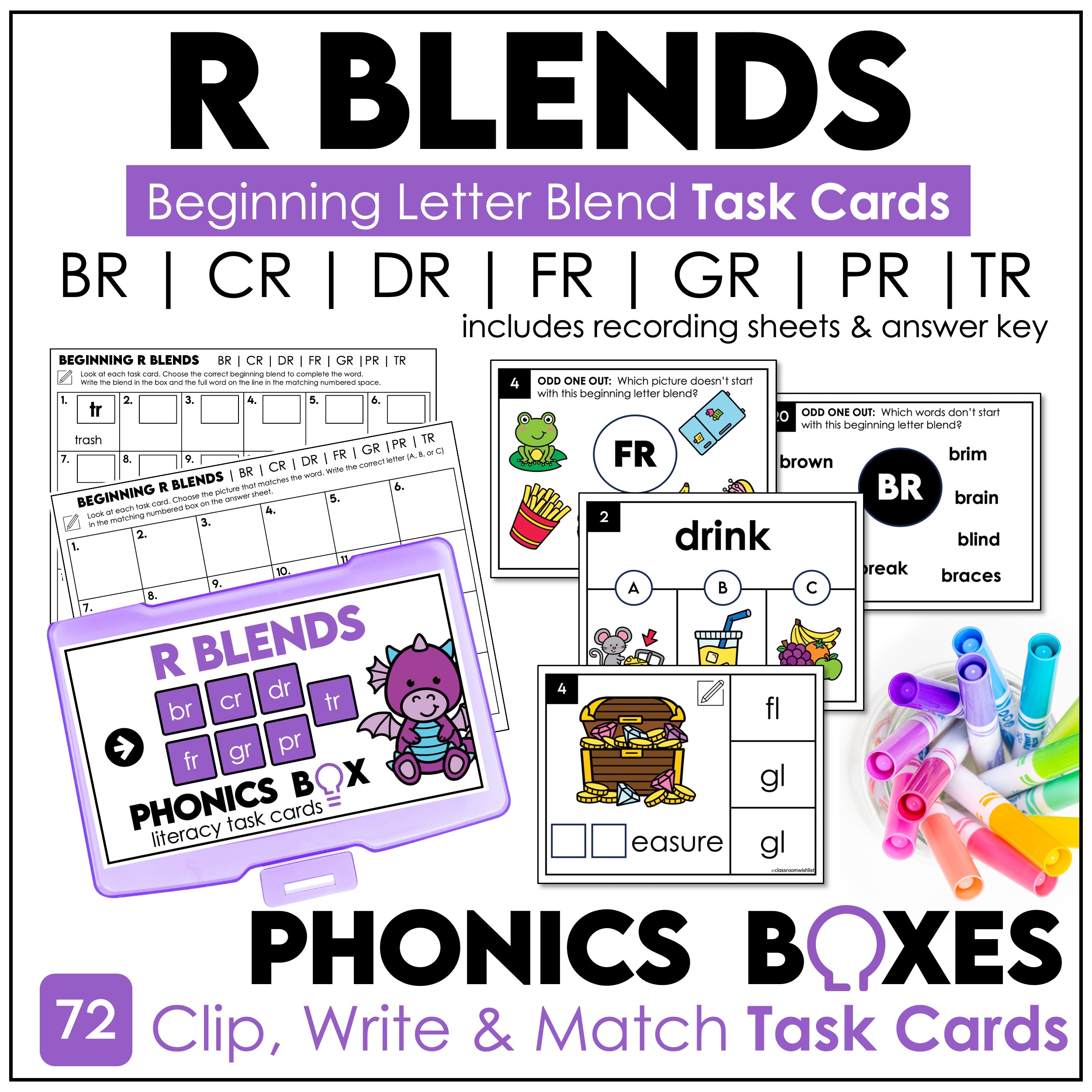
If your students can read CVC words but slow down when words begin with R blends, they need more than another worksheet. They need quick, repeated decoding practice with clear visuals and immediate feedback. These R blends task cards and R blends clip cards help students hear the blend, say both sounds smoothly, and recognize beginning R blend patterns in print.
Get the resource here: R Blends Phonics Task Cards on Hot Chocolate Teachables or R Blends Task Cards on TPT.
What Are R Blends?
R blends are consonant blends where the second sound is /r/. Students need to say both consonant sounds clearly and blend them into the rest of the word.
Common R blend words include:
- br: brush, brick, brown
- cr: crab, crown, crash
- dr: drum, drop, drive
- fr: frog, free, fruit
- gr: green, grapes, grin
- pr: press, prize, proud
- tr: tree, train, truck
For many first graders, the challenge is not knowing the letters. The challenge is blending the sounds smoothly without adding an extra vowel or skipping one of the sounds.
Why Beginning R Blends Need Extra Practice
Students usually need repeated, focused practice before beginning R blends become automatic. A quick mini-lesson is a good start, but most students need to read, hear, sort, and say the blends many times.
Common mistakes to watch for
- Adding an extra vowel: saying “tuh-rain” instead of “train.”
- Dropping the first sound: reading “rain” instead of “brain.”
- Guessing from pictures: choosing the image without reading the word.
A simple fix is to have students tap the first two letters, say the blend quickly, and then read the whole word. For example: /tr/ + ain = train.
R Blends to Teach: BR, CR, DR, FR, GR, PR, and TR
This resource focuses on BR, CR, DR, FR, GR, PR, and TR. Teaching these blends together helps students notice the pattern: two consonants, two sounds, then the vowel.
Before centers or small groups, try a 60-second warm-up:
- Say the blend quickly: /br/.
- Students repeat without adding extra vowel sounds.
- Say a word: brush.
- Repeat with cr, dr, fr, gr, pr, tr.
Hands-On Ways to Practice R Blends
The easiest way to teach R blends activities is to keep the target blends the same but rotate the activity format. This gives students repeated practice without making phonics feel repetitive.
- Day 1: clip cards for blend recognition
- Day 2: word-to-picture matching
- Day 3: odd one out cards
- Day 4: mixed review in centers
- Day 5: quick oral reading check
Using R Blends Task Cards in Phonics Centers
R blends task cards work well in phonics centers because the format is predictable. Students can focus on decoding instead of learning new directions every day.
Center setup
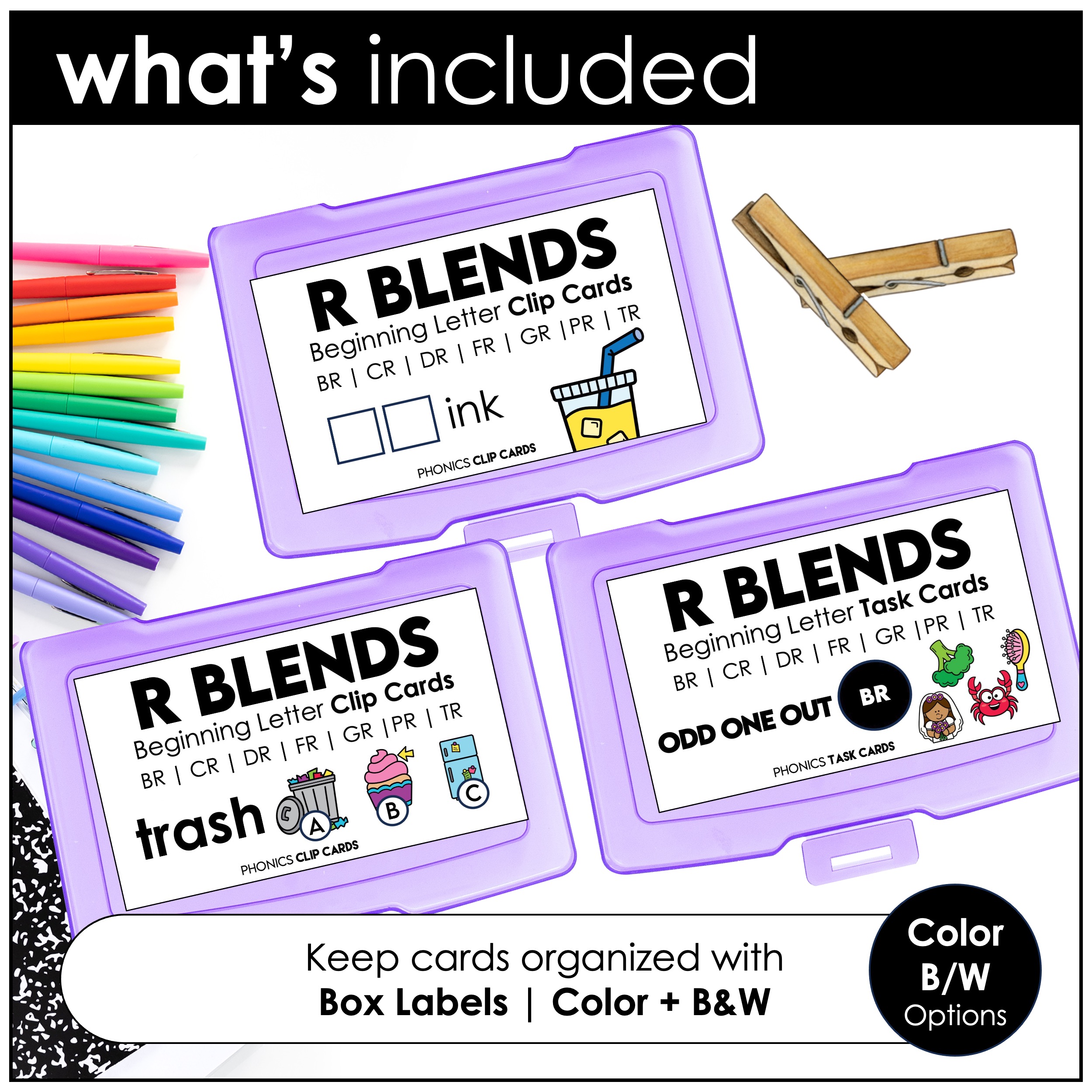
- Store cards in a labeled bin or task card box.
- Add clothespins for clip cards.
- Include a recording sheet if you want accountability.
- Have students read two cards aloud before moving on.
Small Group Ideas for R Blends Practice
Small groups are ideal for R blends reading intervention because you can hear exactly where students are struggling and correct errors right away.
Simple 10-minute routine
- Warm up: practice br, cr, dr, fr, gr, pr, tr aloud.
- Read: students read 6–8 cards aloud.
- Build: students write or build one R blend word.
- Check: students read one sentence with an R blend word.
Example: If a student says “fuh-rog,” model the blend quickly: /fr/. Then have them read: /fr/ + og = frog.
How to Use R Blends Clip Cards
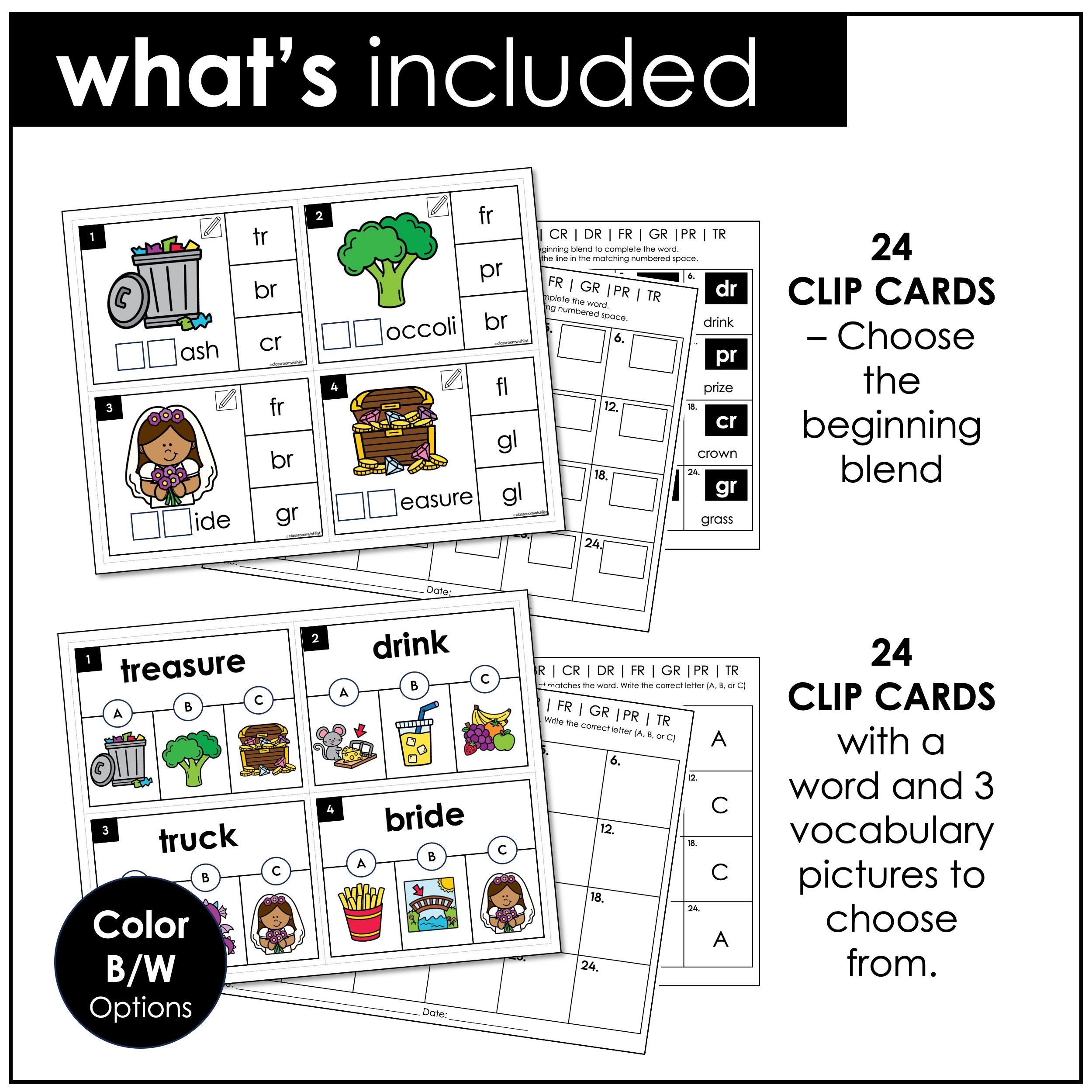
R blends clip cards are perfect for students who need quick, hands-on practice without a lot of writing. Students read the word or picture prompt, identify the beginning blend, and clip the correct answer.
Differentiation ideas
- Support: students whisper-read the word to a partner before clipping.
- Challenge: students use the word in a complete sentence after clipping.
Word-to-Picture Matching for R Blend Words
Word-to-picture matching helps students connect decoding with meaning. Instead of only identifying the blend, students read the full word and match it to the correct image.
To reduce guessing, use a simple “blend tap” routine. Students tap the first two letters, say the blend, and then read the word before choosing the picture.
Odd One Out R Blends Practice
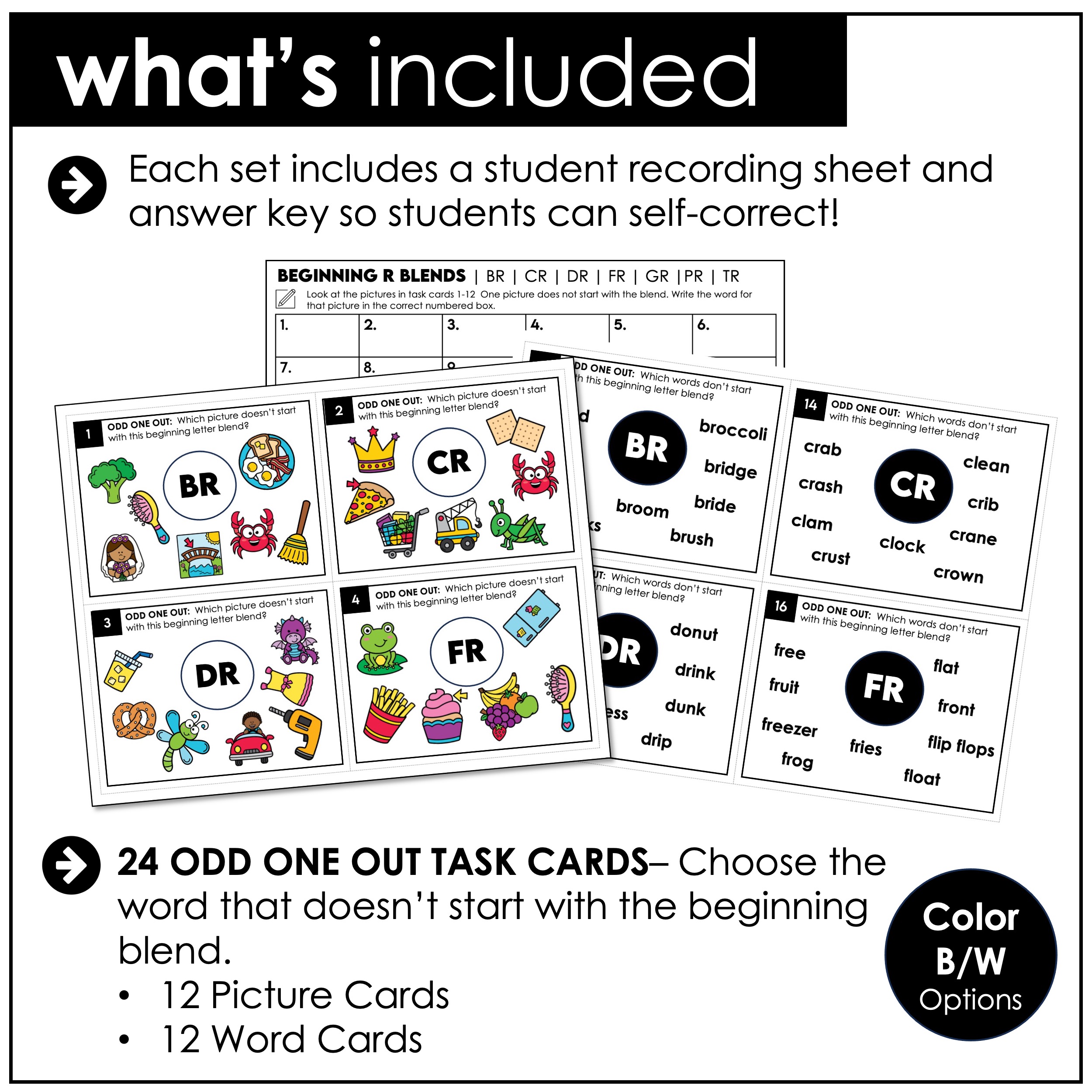
Odd one out cards help students slow down and compare sounds carefully. Students decide which word or picture does not belong, often because it begins with a different R blend.
Teacher tip: Have students explain their answer: “This one starts with gr. The others start with tr.”
What’s Included in the R Blends Task Cards Resource
This set is designed for repeated, hands-on R blends phonics practice in centers, small groups, and intervention.
- Printable R blends task cards for BR, CR, DR, FR, GR, PR, TR
- R blends clip cards
- Word-to-picture matching cards
- Odd one out phonics task cards
- Student recording sheets
- Answer keys
- Color and black-and-white options
- Box labels for organization
Where to Use These R Blends Activities
- Phonics centers: independent beginning blends practice
- Small groups: targeted decoding with teacher support
- Intervention: extra practice for students who need slower blending work
- Morning tubs: hands-on word work
- Early finishers: meaningful phonics review
- Sub plans: predictable tasks with answer keys
Success looks like this: students can identify the beginning R blend, say both consonant sounds smoothly, and read the full word accurately.
Shop the R Blends Task Cards
- R Blends Phonics Task Cards on Hot Chocolate Teachables
- R Blends Task Cards on Teachers Pay Teachers
More Blog Posts You Might Like
- Hands-on L blends practice for first grade phonics centers and small groups
- S blends phonics games with a no-prep routine for bingo, clip cards, and card games
- Teacher Toolkit Membership: unlimited ESL resources for busy teachers
Created by Hot Chocolate Teachables


