

A Teacher’s Guide to Accurate ESL Placement and Level Assessment

Choosing the right English level for an ESL student can shape the entire learning experience. If a student is placed too low, lessons may feel boring or repetitive. If a student is placed too high, they may feel overwhelmed and lose confidence. A strong ESL placement test helps teachers, tutors, language schools, and English programs make better placement decisions from the start.
An accurate English placement test should do more than check grammar. It should give teachers a clear picture of how students use English across several skills: grammar, vocabulary, reading, writing, listening, and speaking. When these areas are assessed together, placement becomes much more reliable.
In this guide, you’ll learn what an effective CEFR placement test should include, how CEFR levels work, why grammar quizzes are not enough, and how to use placement results to support ESL, ELL, EFL, and ESOL learners with confidence.
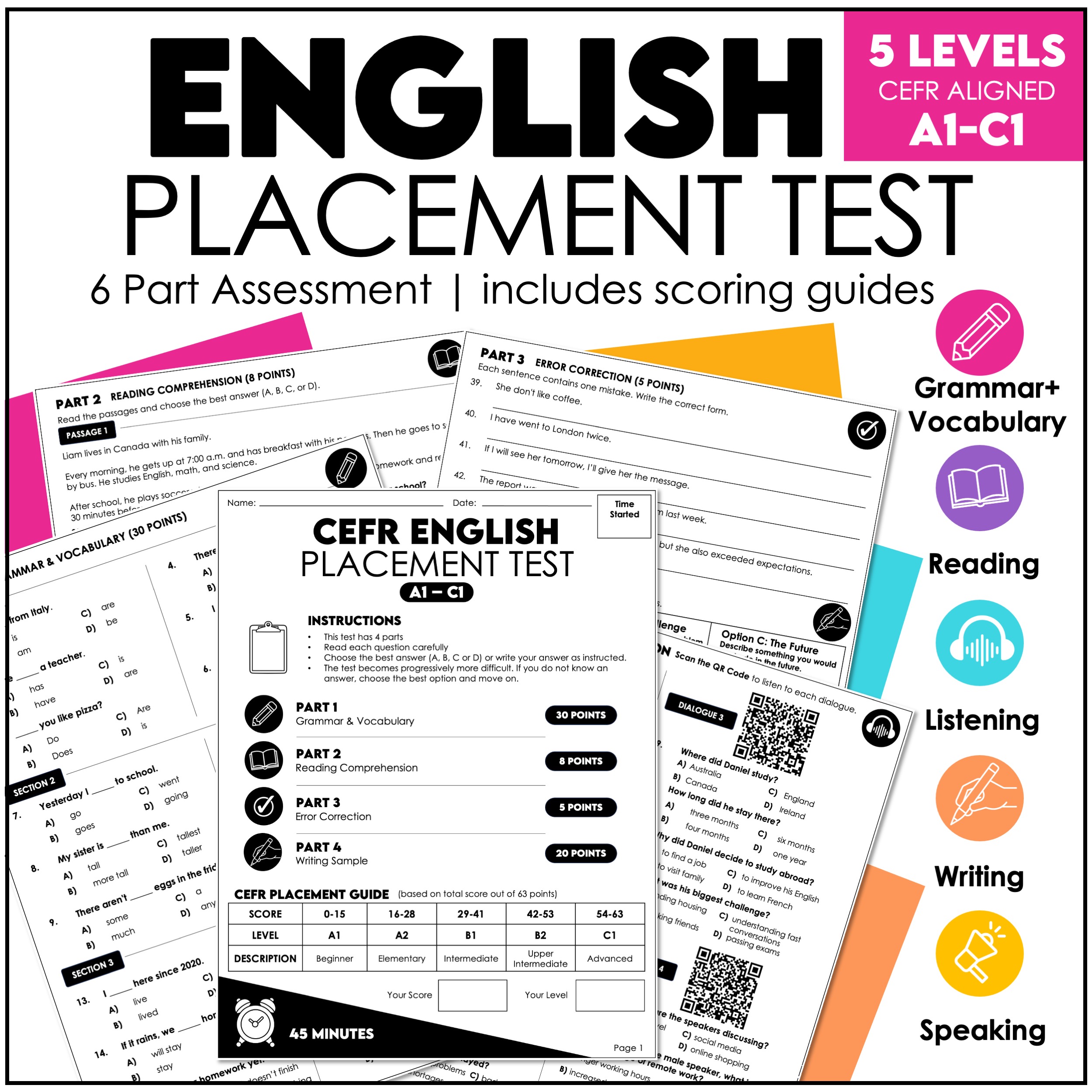
The CEFR English Placement Test from Hot Chocolate Teachables helps teachers assess students from A1 to C1 using a structured, easy-to-score format. You can also find this English Placement Test on Teachers Pay Teachers.
Why Accurate ESL Placement Matters
Accurate placement helps students learn at the right level. When students are placed correctly, they are more likely to feel challenged, supported, and motivated. Teachers also benefit because they can create better groups, choose appropriate materials, and plan lessons that match student needs.
A complete English level assessment helps avoid common placement problems, such as:
- students placed in classes that are too easy or too difficult
- large skill gaps within one group
- students who know grammar but struggle to speak
- students who speak confidently but need writing support
- students who read well but struggle with listening comprehension
- students who need targeted review before moving up a level
Placement testing is not about labeling students. It is about understanding their current English ability so you can teach them more effectively.
What Is a CEFR Placement Test?
A CEFR placement test is an English level assessment that helps identify a student’s language ability using the Common European Framework of Reference for Languages. CEFR levels are commonly used in ESL, EFL, ESOL, tutoring, language schools, adult education, and international classrooms.
The main CEFR levels are:
- A1 Beginner: Students can understand and use very basic phrases, introduce themselves, and answer simple personal questions.
- A2 Elementary: Students can communicate about familiar topics, daily routines, personal information, and basic needs.
- B1 Intermediate: Students can describe experiences, express opinions, understand main ideas, and communicate in many everyday situations.
- B2 Upper Intermediate: Students can discuss more complex topics, explain viewpoints, understand detailed texts, and communicate with more fluency.
- C1 Advanced: Students can use English flexibly and effectively for academic, professional, and social purposes.
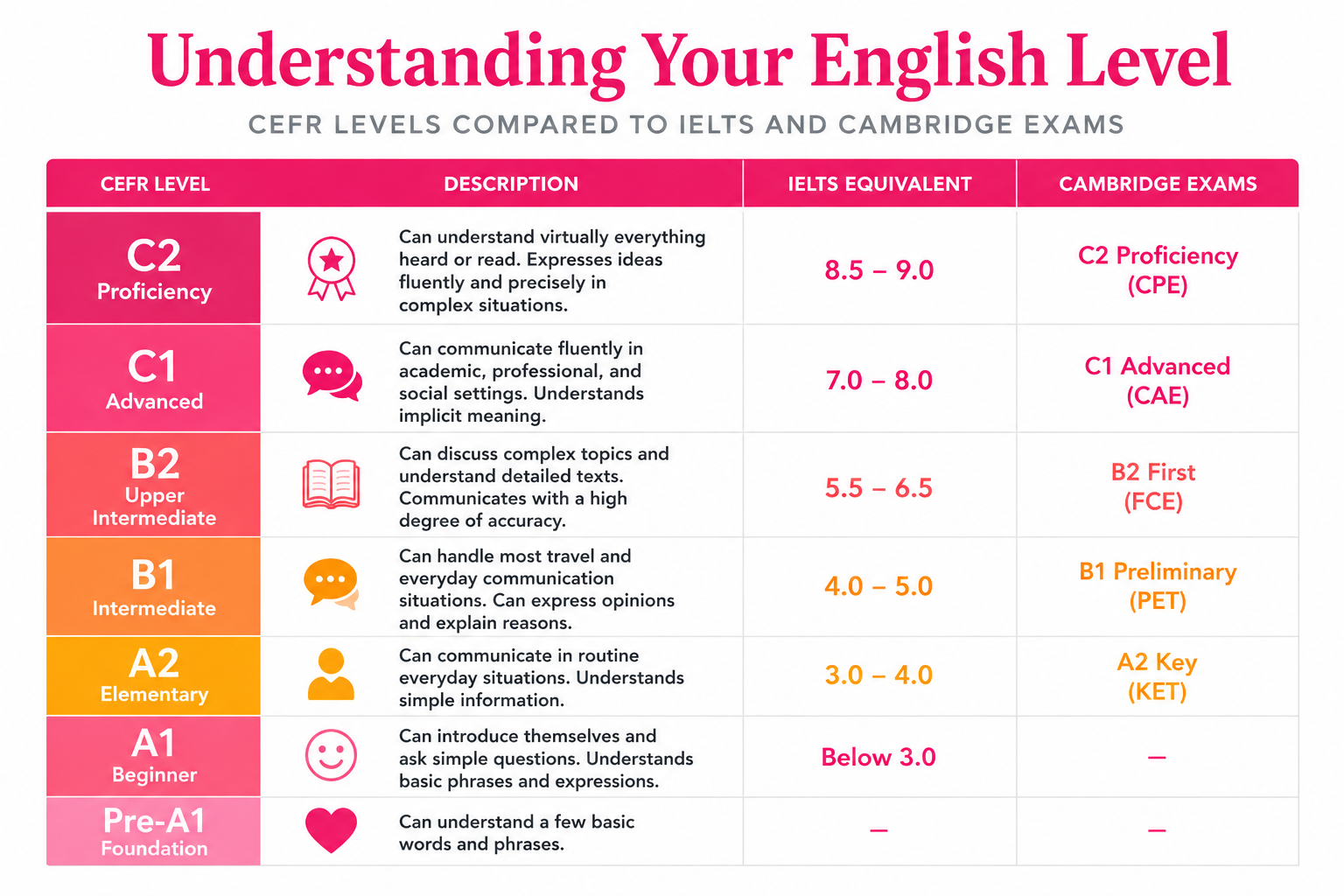
Using CEFR levels gives teachers a consistent way to describe student ability. Instead of using vague labels like “low intermediate” or “pretty advanced,” teachers can use clearer placement language such as A2, B1, B2, or C1.
Why Grammar Tests Alone Are Not Enough
Grammar is important, but grammar alone does not show the full picture of a student’s English proficiency. A student may answer grammar questions correctly on a multiple-choice test but struggle to explain an idea in conversation. Another student may speak fluently but make frequent errors in writing.
A complete ESL placement assessment should include:
- grammar accuracy
- vocabulary knowledge
- reading comprehension
- listening comprehension
- writing ability
- speaking fluency
- error correction
- overall communication skills
When teachers assess multiple skills, they can make better placement decisions and plan instruction with more confidence.
What Should an ESL Placement Test Include?
An effective ESL placement test should include both objective sections and teacher-scored performance tasks. Multiple-choice questions are useful because they are quick to score, but writing and speaking tasks are also essential because they show how students produce English independently.
Grammar and Vocabulary Placement Test
Grammar and vocabulary are the foundation of English communication. Students need to understand common structures, verb forms, sentence patterns, and word meanings to communicate accurately.
A strong grammar and vocabulary placement test helps teachers identify whether students understand basic, intermediate, and advanced English structures. This may include topics such as present simple, past simple, comparatives, prepositions, modal verbs, passive voice, conditionals, relative clauses, and vocabulary in context.
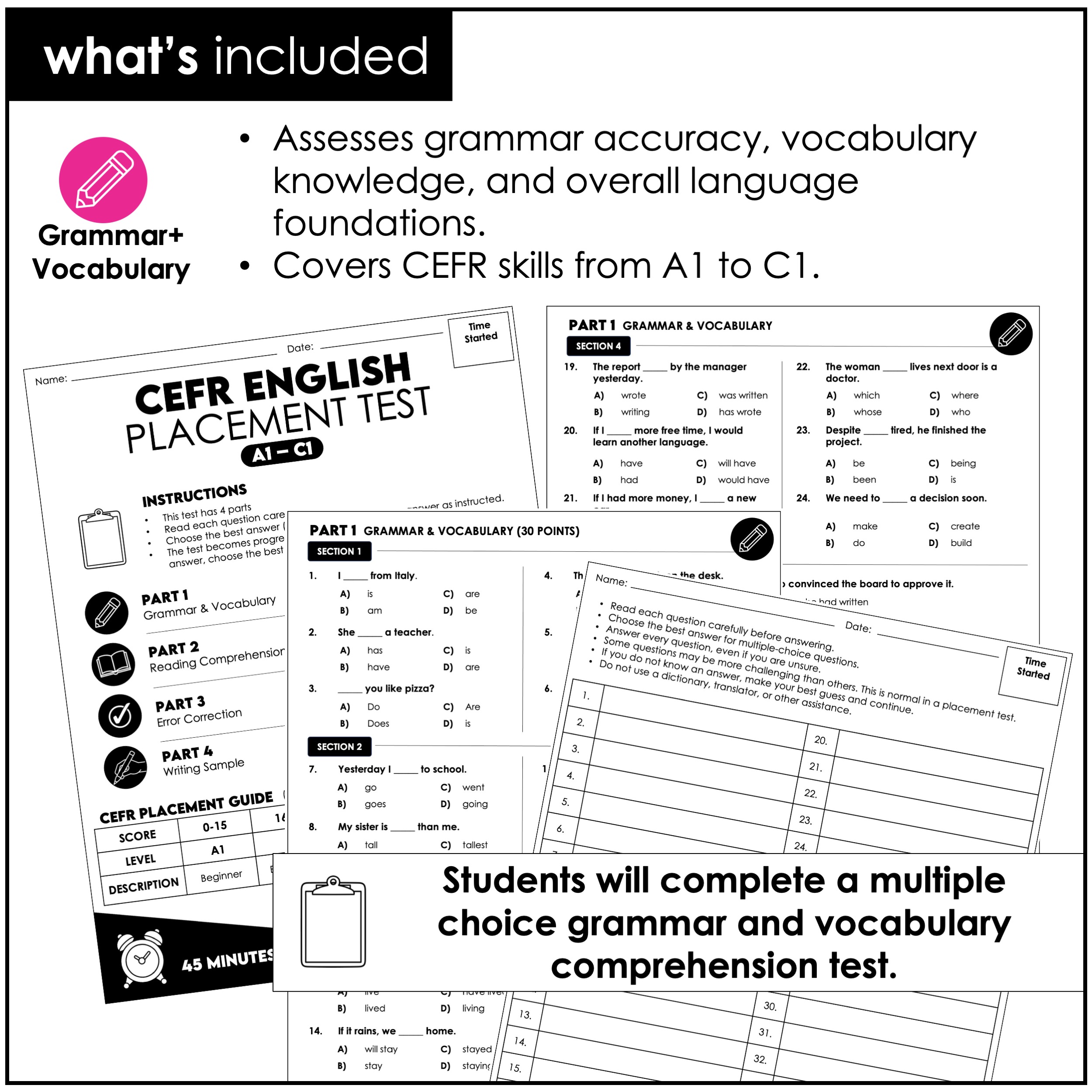
In the CEFR English Placement Test, the grammar and vocabulary section assesses language foundations across CEFR levels from A1 to C1.
Reading Comprehension Placement Assessment
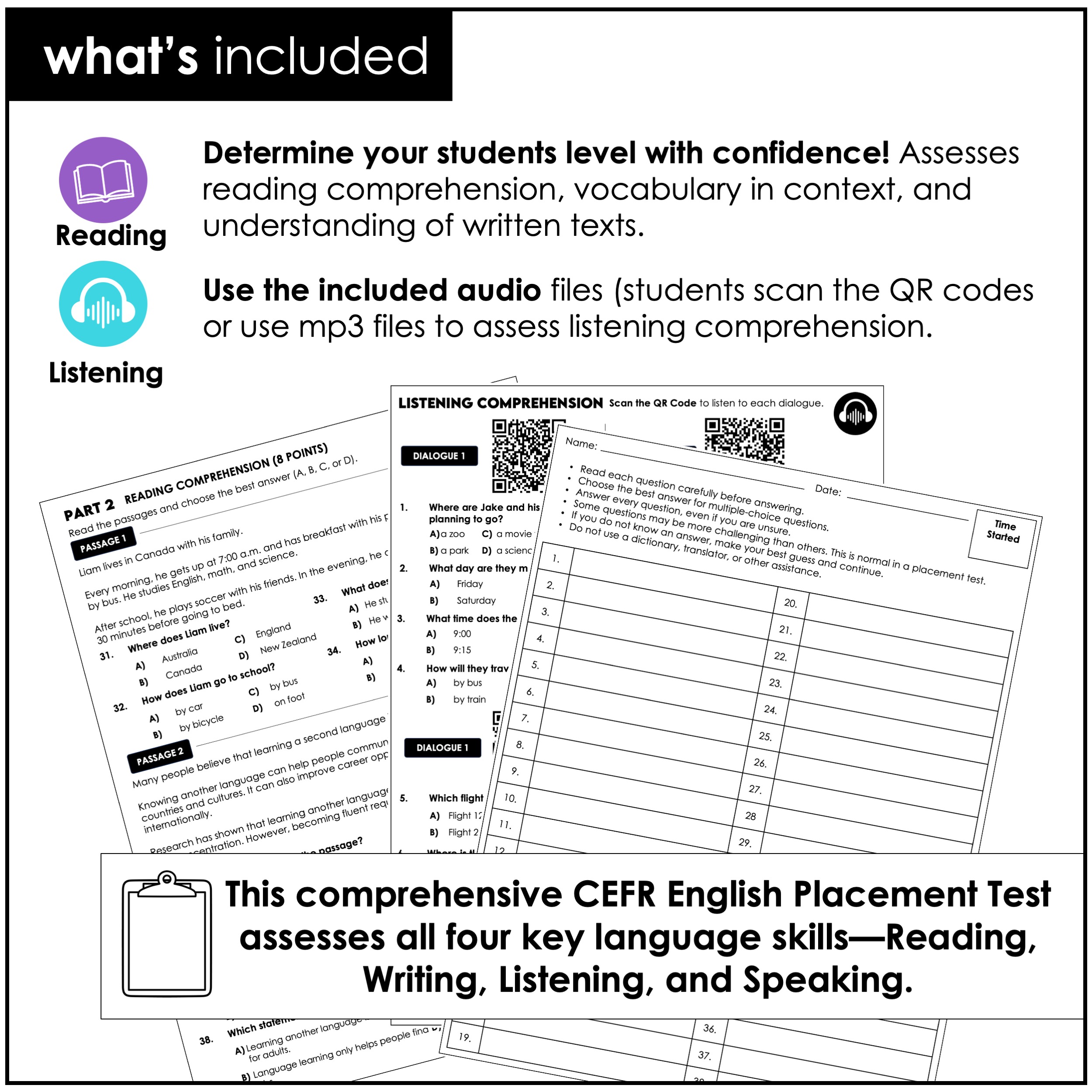
Reading comprehension shows how well students understand written English in context. A reading section helps teachers see whether students can understand the main idea, identify details, use context clues, make simple inferences, and process progressively more challenging texts.
Reading results can help teachers choose appropriate classroom materials, reading passages, homework, and support activities.
Listening Comprehension Placement Assessment
Listening is an essential part of placement because students may perform differently when listening than they do when reading. Some learners can understand written English but struggle with spoken language, especially when speech is natural, fast, or unfamiliar.
A listening assessment helps teachers understand whether students can follow conversations, identify key details, understand spoken information, and process English in real time.
Writing Assessment for ESL Placement
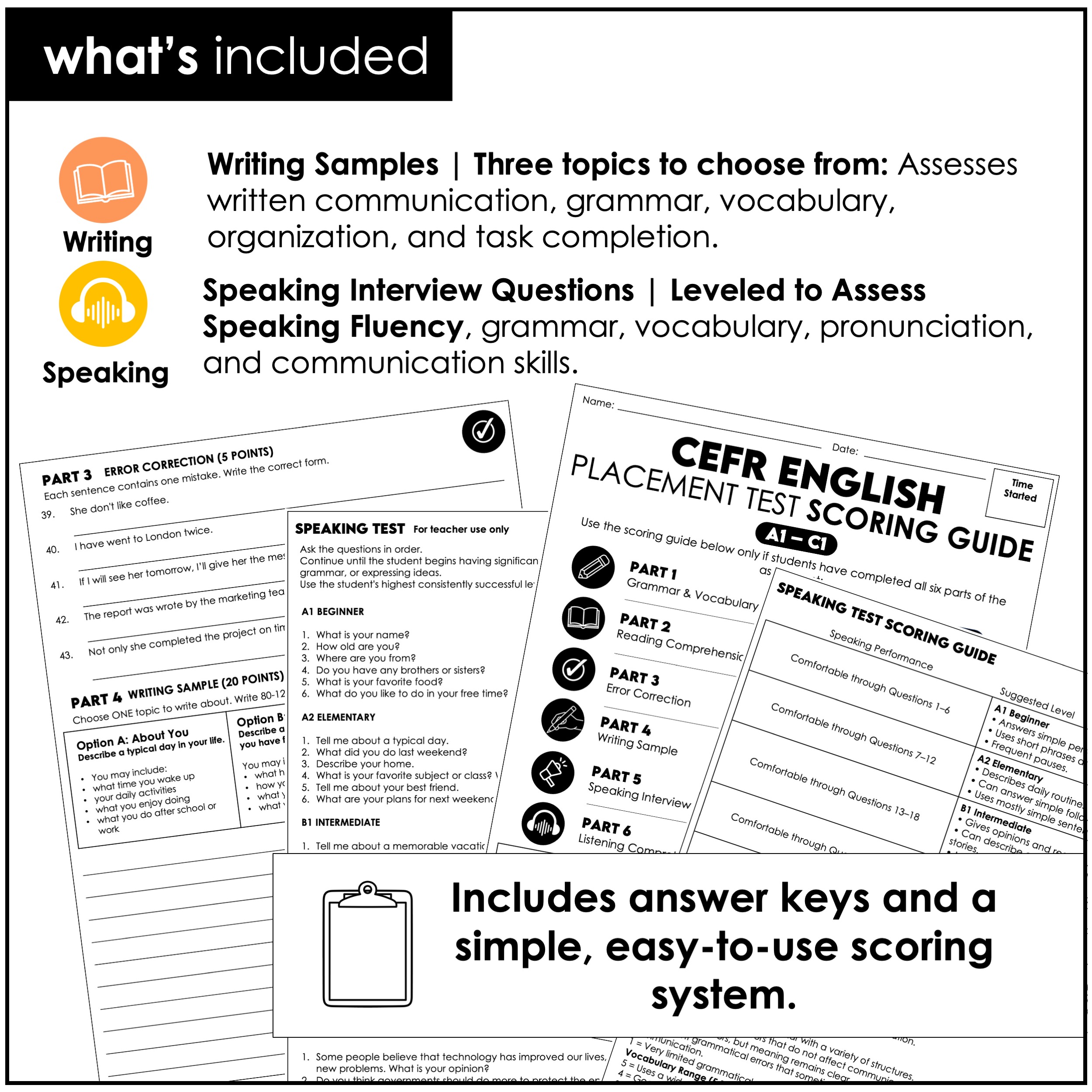
Writing gives teachers a clear look at how students use English independently. A writing sample can reveal grammar control, vocabulary range, sentence structure, organization, spelling, punctuation, and overall communication ability.
The CEFR English Placement Test includes writing prompts and scoring guidance so teachers can evaluate writing more consistently.
Speaking Assessment for ESL Placement
Speaking should be included in any complete English placement test because a student’s speaking level may not match their grammar or reading score. Some students are accurate but hesitant. Others are fluent but make frequent errors. A speaking interview helps teachers see how students communicate in real time.
A useful speaking assessment should evaluate:
- fluency
- pronunciation
- grammar accuracy
- vocabulary range
- comprehension of questions
- ability to expand answers
- overall communication skills
Speaking interview questions and rubrics make placement more consistent and help teachers identify the student’s strongest successful level.
Why Rubrics Make Placement More Reliable
Writing and speaking are more subjective than multiple-choice questions, so rubrics are important. A clear rubric helps teachers score students consistently instead of relying only on a general impression.
Rubrics help teachers:
- score writing and speaking more fairly
- explain placement decisions
- identify strengths and needs
- support progress monitoring
- reduce guesswork
How Long Should an English Placement Test Take?
A placement test should provide enough information for an accurate decision without exhausting the student. For many ESL programs, 45 to 60 minutes is a practical window for the written sections. Speaking interviews can be completed separately.
A practical placement process might include:
- Grammar and vocabulary: 20–30 minutes
- Reading comprehension: 10–15 minutes
- Error correction: 5–10 minutes
- Writing sample: 15–20 minutes
- Listening comprehension: 10–15 minutes
- Speaking interview: 5–10 minutes per student
Who Can Use This CEFR English Placement Test?
A CEFR-aligned English placement test can be used in many teaching settings, including:
- ESL, ELL, EFL, and ESOL classrooms
- language schools
- private tutoring
- adult education programs
- international schools
- homeschool English programs
- new student enrollment
- beginning-of-year assessment
- mid-year placement
How to Use Placement Results After Testing
The purpose of placement testing is not simply to assign a level. The results should help teachers make better instructional decisions.
After testing, teachers can use placement results to:
- create level-based groups
- identify grammar gaps
- choose reading materials
- plan speaking activities
- provide writing support
- differentiate assignments
- track student progress
- set realistic learning goals
How This CEFR Placement Test Supports Teachers
The CEFR English Placement Test from Hot Chocolate Teachables was designed to make ESL placement easier, more complete, and more teacher-friendly. Instead of collecting separate assessments for each skill, teachers can use one organized placement system.
This resource includes:
- CEFR-aligned levels from A1 to C1
- grammar and vocabulary assessment
- reading comprehension section
- error correction section
- writing prompts
- listening comprehension assessment
- speaking interview questions
- answer keys
- writing rubric
- speaking rubric
- placement guide
- student answer sheets
- easy-to-use scoring system
You can find the complete assessment here: CEFR English Placement Test from Hot Chocolate Teachables. It is also available on Teachers Pay Teachers.
Common ESL Placement Mistakes to Avoid
Using Only a Conversation
A quick conversation can be helpful, but it may not reveal reading, writing, grammar, or listening skills. Some students speak confidently but have limited accuracy. Others are quiet during interviews but perform well on written tasks.
Testing Only Grammar
Grammar matters, but it does not measure full language proficiency. Students should be assessed across multiple skills.
Skipping Writing
Writing shows how students use English independently and can reveal patterns that multiple-choice questions miss.
Skipping Listening
Listening comprehension is essential for classroom success. Students need to understand spoken directions, teacher explanations, peer discussions, and audio materials.
Not Using a Rubric
Without rubrics, speaking and writing scores can become inconsistent. Rubrics help teachers score more fairly and clearly.
Final Thoughts
Placing ESL students in the right level is one of the most important steps in supporting language growth. A strong English placement test should give teachers more than a grammar score. It should show how students read, write, listen, speak, and use English in context.
If you need a ready-to-use English level assessment for ESL, ELL, EFL, or ESOL students, the CEFR English Placement Test from Hot Chocolate Teachables gives you a complete system for assessing grammar, vocabulary, reading, writing, listening, and speaking. You can also find this English Placement Test on Teachers Pay Teachers.
Frequently Asked Questions About ESL Placement Tests
What is an ESL placement test?
An ESL placement test is an assessment used to determine a student’s current English proficiency level. It helps teachers place students in the correct class, group, or instructional level.
What is a CEFR placement test?
A CEFR placement test measures English proficiency using CEFR levels such as A1, A2, B1, B2, and C1. These levels help teachers describe student ability clearly and consistently.
What should an English placement test include?
A strong English placement test should include grammar, vocabulary, reading comprehension, listening comprehension, writing, and speaking.
Why is grammar alone not enough for ESL placement?
Grammar alone does not show how well a student can speak, listen, read, or write. A student may know grammar rules but still struggle with communication.
How long should an ESL placement test take?
Most placement tests take about 45 to 60 minutes for the written sections. Speaking interviews can be completed separately in shorter individual sessions.
Can I use this placement test with adult ESL students?
Yes. A CEFR-aligned English placement test can be used with adult learners, language school students, private tutoring students, and older ESL learners.
Does a placement test need a speaking section?
Yes. Speaking is an important part of language proficiency. A speaking section helps teachers understand fluency, pronunciation, vocabulary use, grammar accuracy, and communication skills.
Why are writing rubrics important?
Writing rubrics help teachers score writing samples more consistently and identify specific strengths and areas for improvement.
What CEFR level is beginner?
A1 is generally considered beginner. A2 is elementary, B1 is intermediate, B2 is upper intermediate, and C1 is advanced.
How can teachers use placement test results?
Teachers can use results to group students, plan lessons, choose materials, identify grammar gaps, support speaking practice, and monitor progress over time.
Can this assessment be used as a diagnostic test?
Yes. A complete English level assessment can also help teachers diagnose strengths and weaknesses in grammar, vocabulary, reading, writing, listening, and speaking.


