

ESL Homework Escape Rooms: Grammar Mysteries

If you need homework that students actually complete (and that you can check without losing your weekend), a homework escape room is one of the best low-prep options. Students finish short grammar tasks in a set order, track their progress, and solve a final mystery—so practice feels motivating instead of repetitive.
This teacher guide explains exactly how to use ESL homework escape rooms for two of the most important grammar targets: present vs. past tense verbs and prepositions of time and place. You’ll get setup tips, timing, differentiation, fast checking workflows, and an FAQ section teachers can skim quickly.
What Is a Homework Escape Room?
A homework escape room (also called a take-home escape or grammar mystery) is a structured sequence of practice tasks students complete to “unlock” a final answer. Instead of one long worksheet packet, students move through shorter pages that each target a specific micro-skill. They record answers, earn progress steps, and complete a final “mystery reveal” at the end.
Use This When You Need…
- Better homework completion: students are more likely to finish because they want the final reveal.
- Spiral grammar review: assign one short task per day for steady practice.
- Test prep that doesn’t feel like test prep: students practice the same skills in a more engaging format.
- Independent work in class: perfect for early finishers, stations, and sub days.
- Mixed-level support: easy to scaffold and easy to extend.
The Problem This Solves (And Why It Works)
“My students either don’t do homework, or they do it fast and wrong.”
When homework feels endless, students avoid it. When it feels too easy, they rush it. Homework escape rooms fix both because:
- Tasks are short (less resistance, less overwhelm).
- Students get momentum as they move page to page.
- There’s a clear goal (solve the mystery).
- You can check faster (final reveal + targeted spot checks).
ESL Homework Escape Rooms
These two grammar mysteries are designed to be classroom-friendly, easy to assign, and simple to check. They’re also great for ESL/ELL learners because tasks are structured and focused.
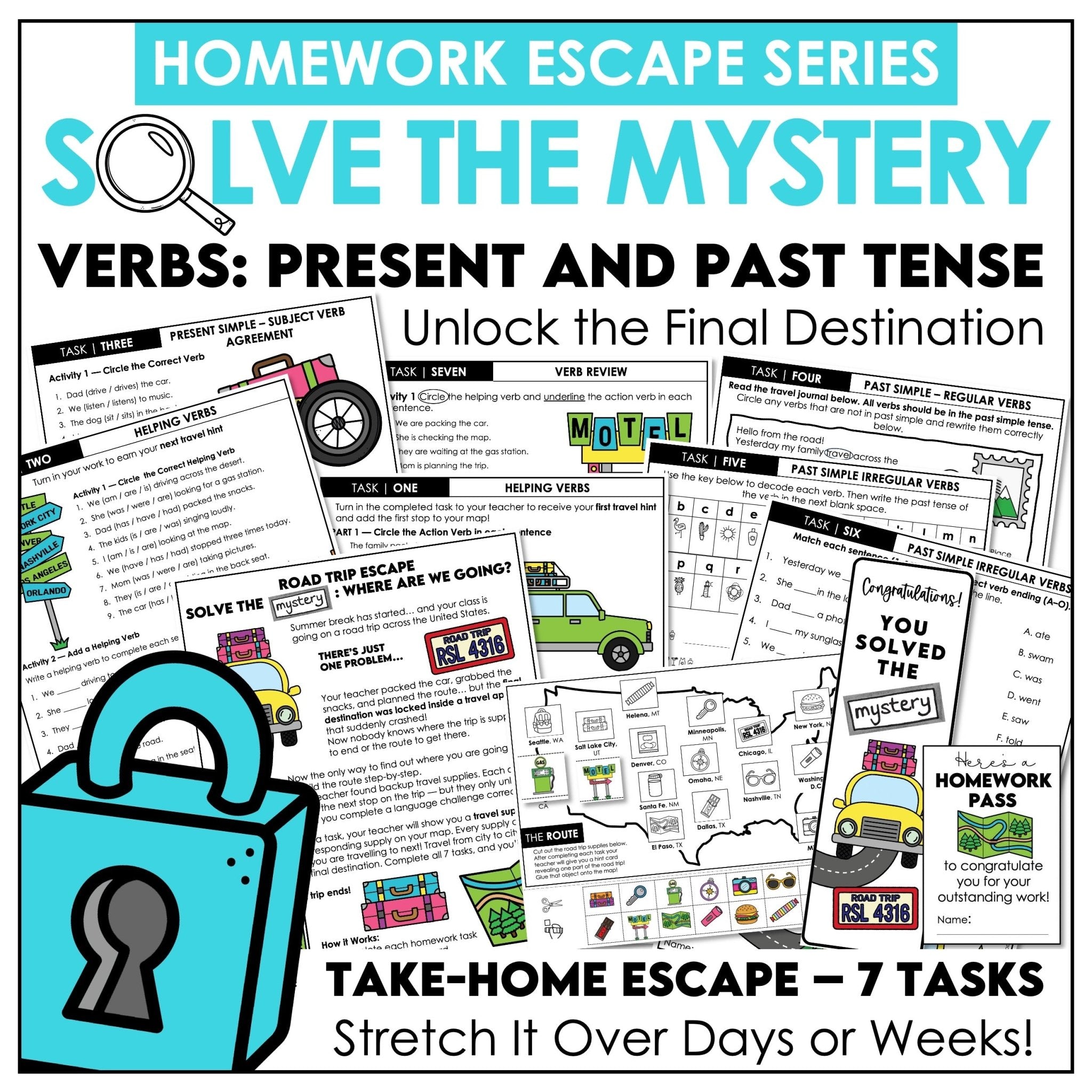
1) Present vs. Past Tense Verbs Homework Escape Room
If your students mix tenses, forget -ed endings, or struggle to connect time markers (yesterday, last week, every day) to correct verb forms, this is the exact practice they need. Students work through targeted tasks and apply tense rules repeatedly in context.
Shop this grammar mystery here: Present & Past Tense Verbs Homework Escape Room
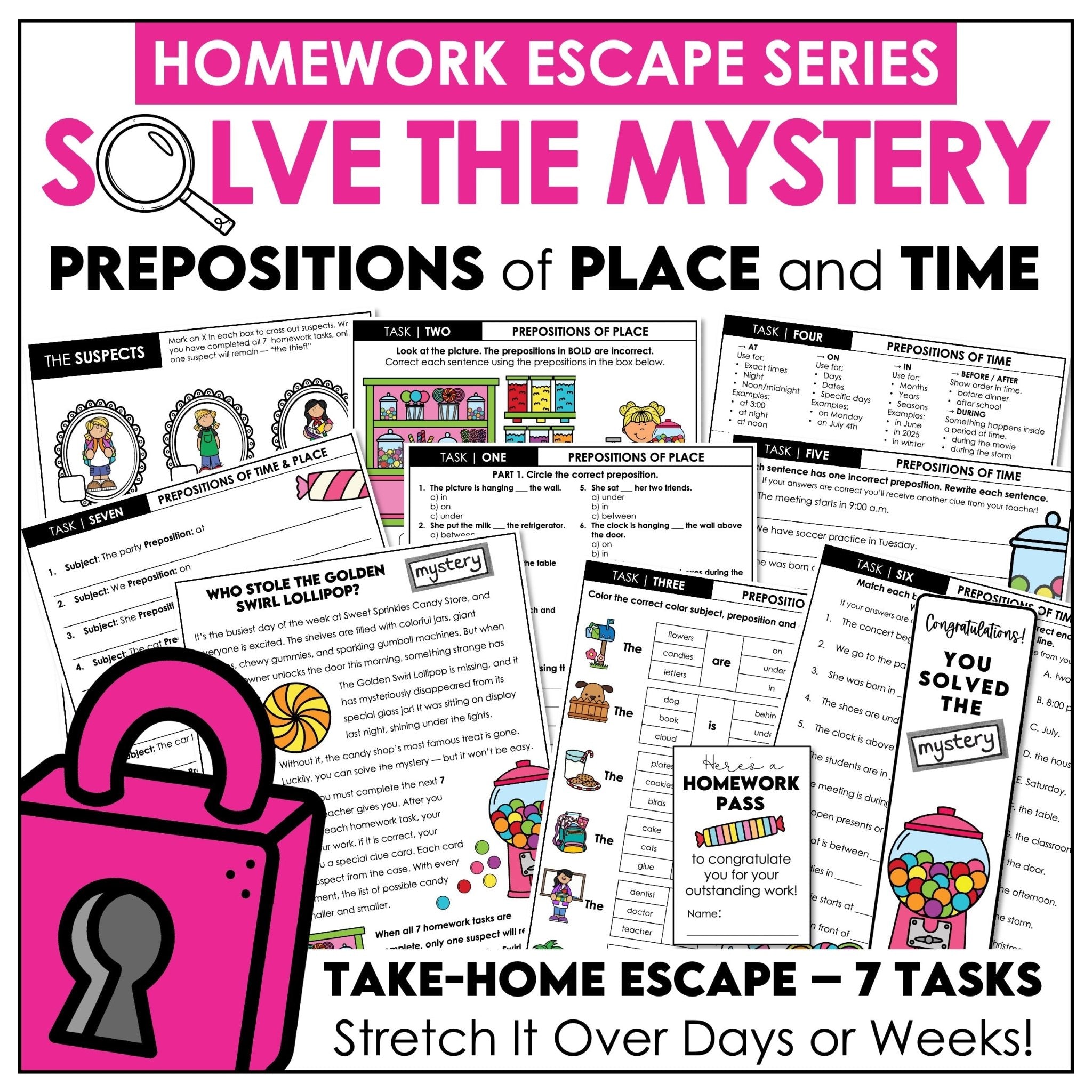
2) Prepositions of Time & Place Homework Escape Room
Prepositions are hard because they’re context-based—and students often overuse one word (usually in) for everything. This escape activity gives students repeated, structured practice with:
- Prepositions of time: in / on / at
- Prepositions of place: in / on / under / behind / next to / between
Shop this grammar mystery here: Prepositions of Time & Place Homework Escape Room
What’s Included (Teacher-Clarity Checklist)
Each homework escape room is designed as a complete, ready-to-use system. You can assign it in class or at home without building your own structure.
- Multiple short task pages (skill-focused, clear directions)
- Student progress tracker (keeps the sequence organized)
- Teacher answer key (fast checking)
- Printable prizes (bookmarks, passes, or certificates)
- Color + black-and-white versions (print based on your budget)
How To Assign It (Print or Digital) + Time Estimates
Materials List
- Printed pages or a digital assignment link
- Pencil (optional: highlighter for grammar targets)
- Optional: stapler or folder (to keep pages together)
Time Needed (Realistic Teacher Numbers)
- Total student time: 20–45 minutes
- Best pacing: 10–15 minutes per day for 2–4 days
- Teacher prep: 5–10 minutes (print + prep directions)
HowTo: Print Version
- Day 1 (2 minutes): Model one sample item as a class.
- Assign pacing: “Complete Task 1 tonight, Task 2 tomorrow,” etc.
- Require order: Students complete tasks sequentially.
- Collect proof: Final mystery reveal + a short reflection sentence.
Proof It Works: 3 Specific Examples (Task + Student Response + Checking)
Example 1 (Prepositions of Place)
Task type: picture-based sentences
Sample response: “The pencil is on the desk.” / “The book is under the chair.”
Fast check: Have students underline the preposition in every sentence. You can scan accuracy quickly.
Example 2 (Present vs Past Tense Verbs)
Task type: choose tense based on time marker
Sample response: “Yesterday I went to the park.” / “Every day she walks home.”
Fast check: Students highlight the time marker first (yesterday/last/every day), then circle the verb. If both match, the answer is usually correct.
Example 3 (Teacher Checking Workflow)
- Quick grading: check the final reveal + 5 target items.
- Self-check option: give the answer key after completion and have students correct in a new color.
- Conference option: pull a small group and correct the top 3 error patterns together.
Differentiation (Without Making More Work for Yourself)
Support Options
- Assign fewer tasks to struggling students (quality over quantity).
- Add a sentence frame: “The ___ is ___ the ___.” / “Yesterday I ___.”
- Allow partner completion in class before sending it home.
Challenge Options
- Write a short story using 8 target verbs or 8 target prepositions.
- Explain the rule: “Why is it on Monday but in July?”
- Create two “wrong” sentences and correct them.
Common Student Mistakes + Quick Fixes
Prepositions
- Overusing “in”: teach “surface vs container” (on surfaces, in containers).
- Confusing in/on/at for time: teach “scale” (in big time, on days, at exact time).
Verb Tense
- Present tense with “yesterday”: require time marker highlighting first.
- Regular vs irregular confusion: keep an irregular mini-list visible and require underlining irregular past forms.
Teacher FAQs
Who is this for?
Upper elementary school ESL/ELL is the sweet spot, but these also work for EFL and intervention groups. The structure helps mixed ability classes stay successful.
How long does it take?
20–45 minutes total depending on your pacing. Many teachers assign one task per day (10–15 minutes) over 2–4 nights to avoid overload.
Is it really low prep?
Yes—print and assign (or post digitally). Optional: print black-and-white and staple into a packet. No special materials needed.
How do I check it quickly?
Check the final mystery reveal first, then spot-check 3–5 key items. You can also use self-check with the answer key and collect only the final page.
Can I use this during class instead of homework?
Definitely. It works for centers, early finishers, review days, and sub plans. Pair work is especially effective for ESL because students talk through the language.
What makes this different from a worksheet packet?
The sequence, variety, and “solve the mystery” structure increases motivation and reduces resistance. Students practice the same skills, but the experience feels like a challenge instead of busywork.
Shop These ESL Homework Escape Rooms
Created by Hot Chocolate Teachables


